 Auditory Scene
At a glance
Unilateral hearing loss means one ear hears normally while the other has a hearing loss; when the loss in the poorer ear is profound, it is called single-sided deafness (SSD).
The main complaints are difficulty hearing in noise, inability to tell where sounds come from and missing speech from the poorer side; tinnitus may accompany it.
Sudden unilateral loss needs urgent assessment; in asymmetric loss an MRI is done to exclude tumours of the internal auditory canal.
Options range from preferential seating and a remote microphone system to a hearing aid, CROS, a bone conduction implant and a cochlear implant.
Medical disclaimer. This content is for informational purposes only and does not replace a physician’s examination, diagnosis or treatment; it should not be used as medical advice. For your complaints or personal situation, always consult an ear, nose and throat physician and an audiologist.
If the hearing in one ear drops suddenly, see an ear, nose and throat doctor the same day or within a few days at most; early treatment matters in sudden hearing loss. A slowly progressive loss, tinnitus or unsteadiness in one ear also needs assessment. If your baby did not pass the newborn screen in one ear, do not delay the diagnostic tests.
Definition and epidemiology
In unilateral hearing loss one ear has hearing within normal limits while the other has a hearing loss. The degree of loss in the poorer ear is graded from the pure-tone average as mild (26-40 dB HL), moderate (41-55), moderately severe (56-70), severe (71-90) or profound (91 dB HL or more). The loss is usually sensorineural; unilateral conductive losses due to aural atresia or chronic middle ear disease are covered in separate entries. When the ears differ but the better ear also has some loss, the term asymmetric hearing loss is used.
Single-sided deafness (SSD), or unilateral profound hearing loss, describes a poorer ear in which speech cannot be understood even with a hearing aid, alongside normal or near-normal hearing in the better ear. Under the approved cochlear implant indication in the United States, SSD is defined as a four-frequency (500, 1000, 2000 and 4000 Hz) average above 80 dB HL in the poorer ear and 30 dB HL or better in the other; if the better ear has a loss of 31-55 dB HL, the term asymmetric hearing loss is used (Dillon et al., 2022). With newborn hearing screening, unilateral losses can now be identified at birth; in adults the loss is usually acquired.
Symptoms and signs
Listening with two ears helps us locate sounds, pick out speech in noise and hear sounds as louder (binaural summation). Most of these advantages are lost with unilateral hearing loss. Because of the head shadow effect, sound arriving from the poorer side reaches the good ear attenuated, especially at high frequencies. People struggle to hear when spoken to on the poorer side, cannot follow conversation in noise and cannot tell where a sound is coming from. Tinnitus and fatigue from listening effort are common.
In children the loss often goes unnoticed because the child responds normally in quiet. Its effects should not be underestimated, however. In Lieu’s (2004) review, 22-35% of school-age children with unilateral loss had repeated at least one year and 12-41% had received additional educational support. In a study comparing 74 children with unilateral loss with their normally hearing siblings, language scores were on average about 10 points lower (Lieu et al., 2010). Inattention in class, missing what the teacher says and behavioural difficulties have also been reported.
Causes and risk factors
In adults the commonest causes are sudden sensorineural hearing loss, Ménière’s disease, trauma and tumours of the internal auditory canal and cerebellopontine angle such as vestibular schwannoma. A retrocochlear cause should always be considered in asymmetric or unilateral sensorineural loss. Mumps, although it can be bilateral, is one of the infection-related hearing losses that typically cause sudden, permanent loss in one ear.
In children, congenital cytomegalovirus (CMV) infection, inner ear malformations and cochlear nerve aplasia or hypoplasia stand out. In 72 children with unilateral loss, MRI showed an absent or hypoplastic cochlear nerve on the affected side in 39%, compared with 5% of those with bilateral loss (Pollaers et al., 2020). Among 17 children with single-sided deafness who were assessed for and accepted a cochlear implant, the cause was congenital CMV in 41% (Sokolov et al., 2017). With causes such as congenital CMV and enlarged vestibular aqueduct, the loss may progress and involve the other ear.
Audiological and clinical assessment
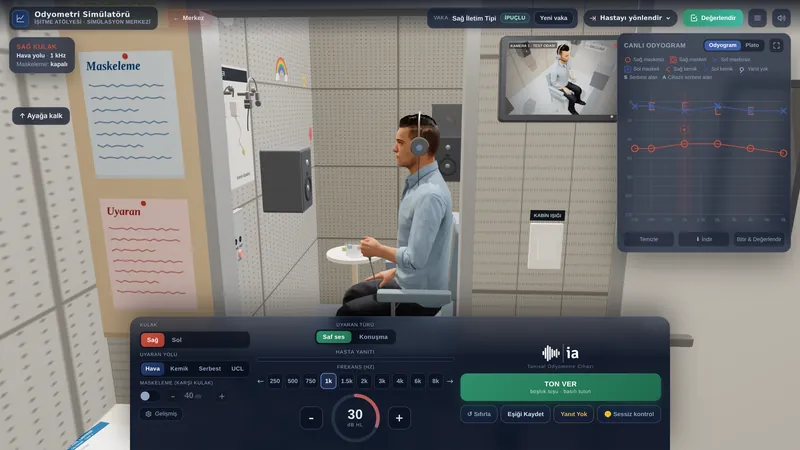
Masking is the most critical point in assessing unilateral loss. Once sound presented to the poorer ear reaches a sufficient level, it crosses through the skull to the better ear; without masking, the poorer ear’s thresholds appear better than they are, as a ‘shadow curve’ that follows the better ear. Crossover is even easier for bone conduction.
- Pure-tone audiometry: air and bone conduction thresholds are obtained with appropriate masking, establishing the type (sensorineural, conductive or mixed) and degree of loss.
- Speech audiometry: word recognition in the poorer ear helps predict whether a hearing aid will help. A score far poorer than the pure-tone threshold suggests retrocochlear disease.
- Tympanometry and acoustic reflexes: assess the middle ear; the ipsilateral and contralateral reflex pattern helps localise the lesion.
- OAEs and ABR: the basis of diagnosis in children. A baby who does not pass newborn screening in one ear has thresholds established by diagnostic ABR. In adults, ABR can be used for retrocochlear screening when MRI is not possible.
- Spatial hearing assessment: speech-in-noise testing with different loudspeaker arrangements and localisation tests are recommended for choosing devices and measuring benefit; the SSQ and spatial hearing questionnaires show everyday difficulty (Dillon et al., 2022).
In asymmetric or unilateral sensorineural loss, contrast-enhanced MRI is arranged to exclude retrocochlear disease. In most adults with acquired SSD, MRI alone is sufficient to assess retrocochlear lesions, labyrinthine ossification and inner ear malformations (Dillon et al., 2022). In children MRI shows the cochlear nerve; because an absent cochlear nerve may rule out a cochlear implant, it must be assessed before any implant decision (Pollaers et al., 2020). If congenital CMV is suspected, the diagnosis is made from a sample taken in the newborn period; requesting imaging and laboratory tests rests with the doctor.
Treatment and audiological rehabilitation
In sudden unilateral loss, the timing of medical treatment matters and decisions rest with the doctor. For a permanent loss, rehabilitation options depend on the degree of loss, age and the person’s needs.
- Preferential seating and communication strategies: sitting in class or meetings so that the better ear faces the speaker and the room, and keeping noise sources on the poorer side.
- Remote microphone system: sends the speaker’s voice directly to the better ear or device, reducing the effects of distance and noise; particularly useful for school-age children.
- Hearing aid: the first option when the poorer ear has a mild to severe loss with adequate word recognition; it can restore part of binaural hearing.
- CROS and bone conduction implants: transfer sound from the poorer side to the better ear, CROS by air conduction and a bone conduction implant by skull vibration. In a meta-analysis in adults, these devices improved speech in noise by a mean of 2.5 dB when speech was on the impaired side, but worsened it by a mean of 3.1 dB when noise was routed to the better ear; hearing-related quality of life improved significantly (Kitterick et al., 2016). They do not restore binaural hearing or localisation.
- Cochlear implant: the only option that can give hearing to the poorer ear in SSD. In the randomised CINGLE trial, cochlear implantation outperformed bone conduction devices and CROS on most measures, and only the implant group improved in localisation (Peters et al., 2021). The American Cochlear Implant Alliance guideline, based on a systematic review, reports a high probability of improvement in speech recognition, localisation, tinnitus and quality of life, and recommends a trial of CROS or a bone conduction device beforehand. Outcomes may be limited in congenital, long-standing SSD (Dillon et al., 2022).
| Option | How it works | Strength | Limitation |
|---|---|---|---|
| CROS | Wirelessly sends sound from the poorer side to the better ear | No surgery | Does not restore localisation |
| Bone conduction implant | Sends sound to the better ear by skull vibration | Ear canal left open | Needs surgery; does not restore localisation |
| Cochlear implant | Directly stimulates the auditory nerve of the poorer ear | Better localisation and tinnitus | Surgery and long rehabilitation; needs a cochlear nerve |
In Türkiye, cochlear implantation for unilateral severe-to-profound loss is not covered by the Social Security Institution (SGK), the national health insurer; suitable patients can still be informed of the option. For CROS systems, reimbursement covers only one unit as a hearing aid, and the other unit is classed as an accessory. This should be discussed openly with the patient when choosing a device.
Children need regular audiological follow-up because the loss may progress, together with monitoring of speech, language and school progress. If a cochlear implant is being considered after sudden loss, the guideline recommends waiting 3-6 months unless there is a risk of labyrinthine ossification; after implantation, use for at least 8 hours a day and auditory training in the first months are important (Dillon et al., 2022).
Impact on quality of life and advice
People with unilateral loss often communicate without difficulty in quiet; problems arise in crowded places, meetings, in the car and when spoken to on the poorer side. Being unable to locate sounds can be a safety issue in traffic and in crowds. Listening carefully all day can lead to fatigue and avoidance of social situations.
For children, school is the key setting. The teacher should know about the loss, the child should sit near the front with the better ear towards the class, and a remote microphone system should be used if needed. Language development and school progress should be monitored and additional support arranged when necessary.
Because your better ear is your only hearing ear, protect it carefully: wear hearing protection in noisy places, remind doctors of your unilateral loss when ototoxic drugs are considered, and seek help at once if the better ear becomes dull, blocked or starts ringing. In meetings and at the table, keep the speaker on your better side.
If you used this review, you can cite it as follows (APA 7):
Auditory Scene. (2026). Unilateral Hearing Loss. Hearing & Balance Health Guide. https://auditoryscene.com/guncel-haberler/categories/isitme-sagligi-rehberi/unilateral-isitme-kaybi/Permanent link: auditoryscene.com/guncel-haberler/categories/isitme-sagligi-rehberi/unilateral-isitme-kaybi/ · Last reviewed: October 2026 · License: CC BY-NC-ND 4.0
References
- Dillon, M. T., Kocharyan, A., Daher, G. S., et al. (2022). American Cochlear Implant Alliance Task Force guidelines for clinical assessment and management of adult cochlear implantation for single-sided deafness. Ear and Hearing, 43(6), 1605-1619.
- Kitterick, P. T., Smith, S. N., & Lucas, L. (2016). Hearing instruments for unilateral severe-to-profound sensorineural hearing loss in adults: A systematic review and meta-analysis. Ear and Hearing, 37(5), 495-507.
- Lieu, J. E. C. (2004). Speech-language and educational consequences of unilateral hearing loss in children. Archives of Otolaryngology-Head & Neck Surgery, 130(5), 524-530.
- Lieu, J. E. C., Tye-Murray, N., Karzon, R. K., et al. (2010). Unilateral hearing loss is associated with worse speech-language scores in children. Pediatrics, 125(6), e1348-e1355.
- Peters, J. P. M., van Heteren, J. A. A., Wendrich, A. W., et al. (2021). Short-term outcomes of cochlear implantation for single-sided deafness compared to bone conduction devices and contralateral routing of sound hearing aids: Results of a randomised controlled trial (CINGLE-trial). PLoS ONE, 16(10), e0257447.
- Pollaers, K., Thompson, A., & Kuthubutheen, J. (2020). Cochlear nerve anomalies in paediatric single-sided deafness: Prevalence and implications for cochlear implantation strategies. The Journal of Laryngology & Otology, 134(11), 1014-1017.
- Sokolov, M., Cushing, S. L., Polonenko, M., et al. (2017). Clinical characteristics of children with single-sided deafness presenting for candidacy assessment for unilateral cochlear implantation. Current Otorhinolaryngology Reports, 5(4), 275-285.
Frequently asked questions
One ear hears well. Does my hearing loss need treating?
That depends on the difficulties you have. Good hearing in one ear protects much of communication in quiet, but hearing in noise, locating sounds and hearing from the poorer side are affected. If you are struggling, discuss hearing aids, CROS, bone conduction implants or a cochlear implant with your audiologist and doctor.
Why have I been asked to have an MRI?
In unilateral or asymmetric sensorineural loss, causes such as a benign tumour of the hearing nerve (vestibular schwannoma) need to be excluded. MRI is the best method for showing these causes and the structure of the inner ear. In children it is also used to check that the cochlear nerve is present.
What is the difference between CROS and a cochlear implant?
CROS picks up sound on the poorer side with a microphone and sends it to the better ear; the poorer ear still does not hear. A cochlear implant directly stimulates the auditory nerve of the poorer ear, giving that ear hearing and potentially improving localisation. It involves surgery and a long period of rehabilitation.
Is a cochlear implant for unilateral loss covered by SGK in Türkiye?
No. Cochlear implantation for unilateral severe-to-profound loss is not reimbursed by SGK, although you can still receive information about the option if you are a suitable candidate. For CROS systems, only one unit is reimbursed as a hearing aid and the other is classed as an accessory.
My child cannot hear in one ear. What should happen at school?
Tell the teacher. Your child should sit near the front with the better ear towards the class. A remote microphone system can help in noisy classrooms. Language and school progress should be monitored and hearing checked regularly, because with some causes the loss can progress or involve the other ear.
How can I protect my better ear?
Wear hearing protection in noisy places, keep the volume low when using headphones, and remind any doctor prescribing medication about your unilateral loss. If your better ear becomes dull, starts ringing or feels blocked, seek help without delay.
Scales that can be used to assess spatial hearing, localisation and everyday hearing difficulty: