 Auditory Scene
At a glance
A sensorineural hearing loss of 30 dB or more across at least three consecutive frequencies, developing within 72 hours.
Sudden fullness, reduced hearing and tinnitus in one ear; some patients also have dizziness.
An emergency. The earlier treatment starts, the better the chance of benefit; seek care the same day.
Corticosteroids (systemic or intratympanic) are given and retrocochlear causes are investigated with MRI; hearing aids, CROS or a cochlear implant are options for permanent loss.
Medical disclaimer. This content is for informational purposes only and does not replace a physician’s examination, diagnosis or treatment; it should not be used as medical advice. For your complaints or personal situation, always consult an ear, nose and throat physician and an audiologist.
If you notice a sudden drop in hearing, fullness or tinnitus in one ear, see an ear, nose and throat doctor the same day. This is a medical emergency; putting it down to water or wax in the ear delays treatment and can lead to permanent hearing loss. If you also feel dizzy, do not wait at all.
Definition and epidemiology
Sudden sensorineural hearing loss (SSNHL) is defined as a sensorineural hearing loss of 30 dB or more across at least three consecutive frequencies, developing within 72 hours. About 90% of cases are idiopathic; in some patients with no cause at presentation, an underlying cause emerges during follow-up (Chandrasekhar et al., 2019).
The annual incidence is reported as 5-27 per 100,000; it can occur at any age, is most common in middle and later life and is usually unilateral (Chandrasekhar et al., 2019). The first AAO-HNS guideline on the condition was published in 2012 and updated in 2019 (Stachler et al., 2012).
Because the lesion lies in the cochlea or auditory nerve, the loss is sensorineural; distinguishing it from a conductive loss is decisive for treatment.
Symptoms and signs
Patients usually wake with, or notice during the day, sudden fullness, reduced hearing and tinnitus in one ear. Being unable to hear on the phone with that ear is a typical presentation.
Dizziness accompanies some cases and generally points to a more severe picture and a poorer outlook.
The symptoms are sometimes mistaken for water or wax in the ear and ignored, which delays treatment. Sudden unilateral hearing loss should therefore never be dismissed.
Causes and risk factors
In most cases no definite cause is found. Proposed mechanisms include viral infection, disturbed inner-ear blood flow, rupture of inner-ear membranes and autoimmune processes (Rauch, 2008).
Identifiable causes include retrocochlear tumours such as vestibular schwannoma, Ménière’s disease, trauma, ototoxic drugs and infections; differential diagnosis is therefore important.
The guideline recommends that every patient with SSNHL be evaluated for retrocochlear pathology with MRI, or with ABR if MRI cannot be performed; audiometric follow-up alone is not considered adequate (Chandrasekhar et al., 2019).
Audiological and clinical assessment
The first step is to establish whether the loss is conductive or sensorineural. Examination and tuning-fork tests (with the Weber lateralising to the better ear) help to exclude outer and middle-ear causes such as wax or effusion quickly. Audiometry should be obtained as soon as possible and within 14 days of onset (Chandrasekhar et al., 2019).
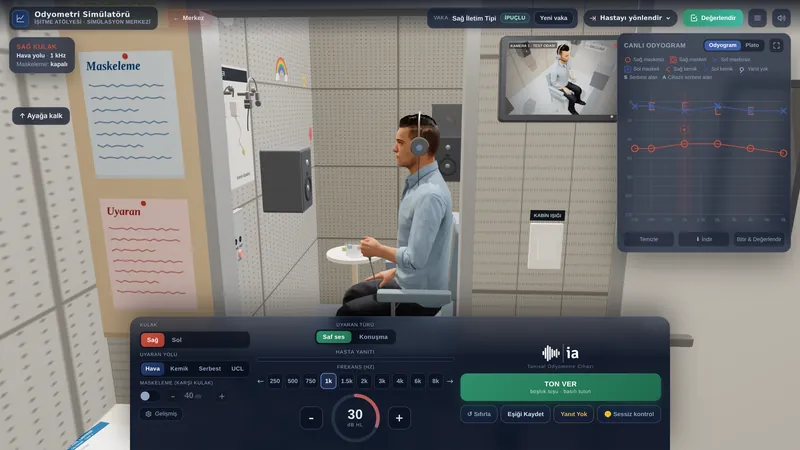
- Pure-tone and speech audiometry: establish the type, degree and configuration of the loss; they are the basis of diagnosis.
- Tympanometry and acoustic reflexes: exclude middle-ear causes.
- Otoacoustic emissions (OAEs): give information on cochlear outer hair cell function.
- MRI: recommended to exclude retrocochlear pathology (e.g. vestibular schwannoma); ABR is used if MRI cannot be done.
- Blood tests and CT: routine laboratory screening and routine head CT in the initial evaluation are not recommended; tests are chosen according to the history.
Treatment and audiological rehabilitation
Corticosteroids can be given orally (systemically) or by injection through the eardrum (intratympanically). The guideline states that corticosteroids may be offered as initial therapy within 2 weeks of onset and that intratympanic steroids should be offered as salvage therapy between 2 and 6 weeks if recovery is incomplete. Hyperbaric oxygen may be an option combined with steroids within 2 weeks of onset, or as salvage within 1 month. Antivirals, thrombolytics and vasodilators are not recommended routinely (Chandrasekhar et al., 2019). The decision and dosing rest with the doctor.
Spontaneous recovery rates of 32-65% are reported, although these figures may overestimate true recovery. Audiometry is repeated at the end of treatment and within 6 months after it (Chandrasekhar et al., 2019).
For patients left with a permanent loss, a hearing aid is the first step in rehabilitation. CROS systems, bone conduction implants and, in selected cases, a cochlear implant are considered for unilateral severe to profound loss, and a cochlear implant for bilateral profound loss.
Impact on quality of life and advice
Even a unilateral loss makes it harder to follow speech in noise and to locate sounds; tinnitus and dizziness can add to anxiety. These effects can be monitored with patient-reported questionnaires.
The most important advice is speed: if you notice a sudden drop in hearing, see a doctor within hours, not days. Even when recovery is partial, hearing aids and communication strategies markedly improve quality of life.
If you used this review, you can cite it as follows (APA 7):
Auditory Scene. (2026). Sudden Hearing Loss (Sudden Sensorineural Hearing Loss). Hearing & Balance Health Guide. https://auditoryscene.com/guncel-haberler/categories/isitme-sagligi-rehberi/ani-isitme-kaybi/Permanent link: auditoryscene.com/guncel-haberler/categories/isitme-sagligi-rehberi/ani-isitme-kaybi/ · Last reviewed: October 2026 · License: CC BY-NC-ND 4.0
References
- Chandrasekhar, S. S., Tsai Do, B. S., Schwartz, S. R., et al. (2019). Clinical practice guideline: Sudden hearing loss (update). Otolaryngology-Head and Neck Surgery, 161(1_suppl), S1-S45.
- Rauch, S. D. (2008). Idiopathic sudden sensorineural hearing loss. New England Journal of Medicine, 359(8), 833-840.
- Stachler, R. J., Chandrasekhar, S. S., Archer, S. M., et al. (2012). Clinical practice guideline: Sudden hearing loss. Otolaryngology-Head and Neck Surgery, 146(3_suppl), S1-S35.
Frequently asked questions
Is sudden hearing loss an emergency?
Yes. Sudden hearing loss is considered a medical emergency because the earlier treatment is started, the higher the chance of hearing recovery. If you notice a sudden decline in hearing, fullness or tinnitus in one ear, it is important to see an ENT physician the same day.
Will my hearing come back?
Some patients recover fully or partially, while in others the loss can be permanent. Recovery depends on the severity of the loss, whether dizziness is present, and the time to starting treatment. Early treatment is the most important positive factor.
Why is an MRI done?
Unilateral sudden hearing loss can, rarely, be the first sign of a benign tumour on the hearing nerve (vestibular schwannoma). MRI is recommended to exclude such causes and to plan care correctly.
Are steroids harmful?
A short course of corticosteroids is usually well tolerated. If you have conditions such as diabetes or high blood pressure, your doctor will plan the dose and route (by mouth or by injection through the eardrum) accordingly. Share any concerns about side effects with your doctor.
What can I do if my hearing doesn’t come back?
For a permanent loss, options such as hearing aids, CROS systems and bone conduction implants for unilateral loss, and cochlear implants for profound loss, markedly improve quality of life. Your audiologist will work out the most suitable solution with you.
Scales that can be used to monitor hearing handicap and hearing-aid benefit in permanent loss: