 Auditory Scene
Cochlear Implants
How they work, who is a candidate, surgery, activation and programming, outcomes and daily life with an implant. Written for audiology students and clinicians with current sources; families will find it useful too.
Last reviewed: October 2026
For information: This page is a summary guide for students and clinicians; candidacy, surgery and programming decisions are made together with the implant team. Information is drawn from international guidelines, peer-reviewed studies and the Turkish Health Implementation Communiqué; sources are listed under each section and at the end of the page.
Overview
A cochlear implant is a surgically placed auditory prosthesis for severe to profound sensorineural hearing loss, in which most of the hair cells in the inner ear no longer work. A hearing aid makes sound louder so that the remaining hair cells can pick it up; a cochlear implant bypasses the damaged part of the cochlea and stimulates the auditory nerve directly with electrical current. Over time, the brain learns to interpret this stimulation as sound.
The device has two parts: an external part worn behind the ear or on the head, and an internal part placed under the skin during surgery, with its electrode array inserted into the cochlea. By 2022, the number of cochlear implants placed worldwide was estimated to have reached one million. The first implantation in Türkiye was performed in Eskişehir in 1987.
Realistic expectations. A cochlear implant does not restore normal hearing. Sounds may seem artificial or mechanical at first; for most people this fades within weeks. Outcomes vary widely from person to person, and no preoperative test can predict them with certainty.
| Hearing aid | Cochlear implant | |
|---|---|---|
| Principle | Amplifies sound for the remaining hair cells | Bypasses hair cells and stimulates the auditory nerve electrically |
| Suitable hearing loss | Mild to profound | Severe to profound sensorineural loss with limited benefit from hearing aids |
| Surgery | Not needed | Needed (general anaesthesia) |
| Adjustment | Hearing aid fitting | Programming: regular sessions from activation onwards |
| Getting used to it | Usually a few weeks | A learning period of months, supported by auditory training |
Source: NIDCD (2016, updated 2021); FDA, Benefits and Risks of Cochlear Implants; Zeng (2022); Öztürk (2005), Uludağ University ENT seminar notes.
From sound to auditory nerve
- 1
Microphone
Microphones on the sound processor pick up sound.
- 2
Sound processor
Splits sound into frequency bands, extracts the amplitude envelope of each band and maps it to the person’s electrical dynamic range.
- 3
Coil
Sends the coded signal and the power it needs across the skin to the internal part; the magnet in the internal part holds it in place.
- 4
Internal part
Decodes the signal and delivers it as electrical stimulation to the electrodes on the array.
- 5
Auditory nerve
The stimulated nerve fibres carry the signal to the brain, which interprets it as sound.
External part
- Sound processor: behind-the-ear models, and single-unit off-the-ear models that combine processor and coil on the head.
- Microphones and controls: pick up sound and allow program and volume changes.
- Coil and magnet: sit on the head over the internal part.
- Battery: rechargeable or disposable.
Internal part
- Body: placed under the skin behind the ear, on the skull; it houses the electronics that decode the signal and the magnet.
- Electrode array: inserted into the scala tympani of the cochlea. Depending on the manufacturer it carries 12 to 22 electrodes.
- Reference electrode: completes the current path.
Source: NIDCD (2016, updated 2021); Loizou, Introduction to cochlear implants; Dhanasingh et al. (2024).
Each electrode stimulates a frequency region
The cochlea is organised by frequency: high frequencies are detected at the base and low frequencies at the apex. A cochlear implant makes use of this layout.
Hover over or tap an electrode to see its channel frequency and hear a pure tone at that frequency.
- The sound processor splits sound into frequency bands and sends each band to the electrode that corresponds to that frequency region. Basal electrodes therefore carry high-frequency sounds and apical electrodes low-frequency sounds.
- Electrodes are not stimulated at the same time but with brief, interleaved pulses, so that the currents of neighbouring electrodes do not interfere. Even so, current spread means that the number of independent channels is smaller than the number of electrodes. We discussed the optogenetic approach, which aims to confine stimulation to a narrower region, in this article.
- The array does not reach the whole length of the cochlea; insertion depth depends on the array and the cochlea. Lateral wall (straight) and perimodiolar (precurved) arrays give similar clinical results.
- Envelope-based coding is usually enough for understanding speech in quiet, but because it does not convey fine timing information at low frequencies, speech in noise and music are harder.
You can explore the cochlea from the travelling wave to implant stimulation in 3D in the Cochlea Simulator, and listen to how a processor splits sound into channels in the Vocoder Simulator. A vocoder shows how the signal is processed, not how implant users actually hear.
Source: Loizou, Introduction to cochlear implants (UT Dallas); Wilson and Dorman (2008); Buchman et al. (2020); Dhanasingh et al. (2024); Zeng (2022).
Who can be a candidate?
Candidacy is not decided by the audiogram alone but by how well a person understands speech with appropriately fitted hearing aids. The decision is made by a team of an ENT surgeon, an audiologist, a speech and language therapist and, where needed, a psychologist.
Adults
Adults with bilateral severe to profound sensorineural hearing loss who still struggle to understand speech after using appropriate hearing aids for at least a few months.
- There is no upper age limit. According to an international consensus statement, age alone should not limit candidacy.
- A long period without hearing aids does not rule out benefit, although average outcomes are lower the longer the hearing loss has lasted.
Children
Children with severe to profound sensorineural hearing loss who do not achieve age-appropriate auditory and language development with hearing aids.
- When auditory deprivation does not exceed about 3.5 years, auditory cortical responses reach age-appropriate levels within 6 months of stimulation.
- International consensus recommends simultaneous bilateral implantation once candidacy is confirmed. In Türkiye, the lower age limit for reimbursement is 12 months.
Expanding indications
- Single-sided deafness and asymmetric hearing loss: approved in the United States since 2019 for ages 5 and over. In a randomised controlled trial comparing a cochlear implant, a bone conduction device and CROS, only the cochlear implant improved sound localisation and tinnitus burden. Not covered by reimbursement in Türkiye. For a detailed discussion see Cochlear Implantation in Single-Sided Deafness.
- Residual hearing: people with relatively good low-frequency hearing and severe high-frequency loss may use electric-acoustic stimulation (EAS): low frequencies are delivered acoustically and high frequencies electrically in the same ear. In a multicentre trial, functional acoustic hearing was preserved in 66% of users at 6 months.
- Auditory neuropathy spectrum disorder (ANSD): in a meta-analysis, one-year speech outcomes in children with ANSD were similar to those in children with other sensorineural hearing loss.
- Hearing loss after meningitis: the cochlea can start to ossify within weeks, and early CT does not always show it, so evaluation is urgent.
- Inner ear malformations: specific electrodes and surgical planning are needed depending on the malformation type. In cochlear nerve aplasia/hypoplasia or an absent cochlea, an auditory brainstem implant may be considered.
When to refer? Under the “60/60” referral guideline proposed in the United States, an adult with a pure-tone average of 60 dB HL or worse in the better ear and an unaided monosyllabic word recognition score of 60% or less is referred to an implant centre for a full evaluation. In a retrospective study this rule identified 96% of candidates. It is a referral rule, not a candidacy criterion.
Criteria differ between countries
| Regulation | Hearing thresholds | Speech test | Hearing aid trial |
|---|---|---|---|
| SUT 3.3.33.B Türkiye, 2023 | Average of 500, 1000, 2000 and 4000 Hz worse than 80 dB, or 70 dB in one ear and 90 dB or worse in the other; at age 2 and under, worse than 90 dB HL bilaterally | Speech discrimination below 30% (if testable) | At least 3 months, binaural |
| NICE TA566 England, 2019 | Worse than 80 dB HL at two or more frequencies between 500 and 4000 Hz, bilaterally | Phoneme score below 50% on the AB word test at 70 dBA | At least 3 months |
| CMS NCD 50.3 US Medicare, 2022 | Bilateral moderate to profound sensorineural loss | Open-set sentence recognition of 60% or less in the best-aided condition | Limited benefit from appropriate hearing aids |
Source: SUT 3.3.33.B (Official Gazette 16.03.2023, no. 32134 bis); NICE TA566 (2019); CMS NCD 50.3 (2022); Buchman et al. (2020); Sharma et al. (2002); Peters et al. (2021); Roland et al. (2016); Bernardes et al. (2024); Singhal et al. (2020); Sennaroğlu and Bajin (2017); Ramsden et al. (2012); Zwolan et al. (2020).
Reimbursement criteria in Türkiye
The Social Security Institution (SGK) covers cochlear implants when the conditions in article 3.3.33.B of the Health Implementation Communiqué (SUT) are met. Auditory implants are covered only when performed at tertiary care hospitals. A summary is given below; for documents and the application process see the SGK Reimbursement guide.
Core conditions
- Bilateral severe to profound sensorineural hearing loss.
- No benefit from at least 3 months of binaural hearing aid use. This is not required for hearing loss after meningitis.
- Over age 2 and in adults, an average threshold at 500, 1000, 2000 and 4000 Hz worse than 80 dB, or 70 dB in one ear and 90 dB or worse in the other; where testable, a speech discrimination score below 30%. At age 2 and under, hearing loss worse than 90 dB HL bilaterally.
- One of the following: a gap of less than 4 years between language age and chronological age, or a language age of 4 or more between ages 4 and 18; or postlingual hearing loss (acquired after language development).
- High-resolution CT and/or MRI showing that the inner ear is developed enough for electrode insertion and that the cochlear nerve is present.
- In ANSD, no benefit from at least 6 months of auditory rehabilitation and training.
- Not covered under 12 months of age; there is no upper age limit.
Medical report
A health board report issued by 3 ENT specialists working at the same hospital. The report includes an audiological evaluation by an audiologist and an evaluation by a psychologist or a speech and language therapist from the same hospital. Cases outside the criteria can be covered with the approval of the Ministry of Health Scientific Advisory Commission on Auditory Implants.
Bilateral implantation
Simultaneous or sequential bilateral implantation is covered only for children aged 12-48 months who meet the cochlear implant criteria; for postlingual hearing loss after meningitis (no age limit); and for people older than 48 months with bilateral visual impairment.
Electric-acoustic implant
Thresholds at 500 and 1000 Hz must be 50 dB or better, thresholds at 2000, 3000 and 4000 Hz 80 dB or worse, speech discrimination worse than 50%, and the report must state that thresholds have been stable for the past year.
Replacement of parts
| Part | Interval or quantity in the SUT annex lists |
|---|---|
| Sound processor (“speech processor” in the SUT) | Every 7 years; earlier with a report and a manufacturer’s technical report if repair is not possible |
| Coil (“transmitter” in the SUT) and battery holder | Every 2 years outside warranty |
| Battery | Up to 1 per implant per day; rechargeable batteries are not covered |
| Cable | Per year: 5 at ages 0-5, 3 at ages 5-10, 2 over age 10 |
- Batteries, battery holder, coil and cable for the first year are included in the surgical package.
- Cochlear implants for single-sided deafness are not reimbursed, because the SUT criteria require bilateral hearing loss.
- No additional fee is charged for auditory implant procedures for patients under 18.
Source: SUT 3.3.33.B (Official Gazette 16.03.2023, no. 32134 bis); replacement intervals from the SUT annex lists (Official Gazette 26.11.2016, no. 29900); additional fees SUT 1.9.3 (Official Gazette 25.08.2022, no. 31934 bis). Regulations may change; check the current SUT text before any application.
The evaluation process
A candidacy evaluation takes from a few weeks to a few months. Its aim is to establish whether an implant is likely to offer more benefit than hearing aids and whether surgery can be performed safely.
Audiological evaluation
Air and bone conduction pure-tone thresholds, speech audiometry, tympanometry and acoustic reflexes, OAE. In infants and young children hearing levels are established with objective tests such as ABR and ASSR.
Aided evaluation
With appropriately fitted hearing aids, sound-field thresholds and word and sentence tests in quiet and in noise are measured. In Turkish, the Turkish Matrix Sentence Test, the Turkish HINT, HINT-C for children and Turkish monosyllabic word lists are used; for children, auditory perception and language tools such as ÇİAT and TEDİL are available.
Imaging
High-resolution CT shows the bony anatomy of the cochlea, malformations and ossification; MRI shows the cochlear nerve, the membranous labyrinth and the brain. In 56 paediatric implant candidates, MRI detected a cochlear nerve anomaly in 12%.
ENT, anaesthesia and vaccination
Middle ear health and general fitness for surgery are assessed. International recommendations advise completing pneumococcal vaccination at least 2 weeks before surgery; review your vaccination status with your doctor.
Speech, language and development
Language age and developmental level are assessed in children, communication needs in adults. In Türkiye, the medical report includes an evaluation by a psychologist or a speech and language therapist.
Balance
Because surgery can affect the vestibular organ, a vestibular assessment is recommended, especially before implanting the second ear.
Counselling and expectations
The likely range of outcomes, the effort rehabilitation requires, device care, family involvement and communication options are discussed.
Source: AAA Clinical Practice Guideline: Cochlear Implants (2019); Parry et al. (2005); CDC (2026); Zokoll et al. (2015); Çekiç and Sennaroğlu (2008); Kartal Özcan et al. (2023); İçöz (2022); Güven and Topbaş (2014).
Surgery
Cochlear implantation is ear surgery under general anaesthesia, not brain surgery. It usually takes 1 to 3 hours, and most centres keep patients in hospital for one night.
Incision and bed
Through an incision behind the ear, a bed is prepared in the bone for the body of the internal part.
Mastoidectomy and posterior tympanotomy
The mastoid is opened and the middle ear is reached alongside the facial nerve.
Electrode insertion
The array is inserted into the scala tympani through the round window or a cochleostomy.
Intraoperative measurements
Impedance and ECAP measurements confirm that the electrodes work; if needed, electrode position is checked with imaging.
Closure
The incision is closed. The internal part is not switched on until activation.
In candidates with residual hearing, atraumatic (soft) surgery principles are followed: slow insertion, keeping blood and bone dust out of the cochlea, and steroids. Robotic and image-guided access and intraoperative electrocochleography monitoring are under study and are not yet standard practice.
Risks and how often they occur
| Event | Rate | Study |
|---|---|---|
| All complications | 13.7% | 1,148 implants, Istanbul |
| All complications | 19.9% | 403 patients, France |
| Major complications (requiring revision surgery or hospital management) | about 5% | similar in both series |
| Delayed facial palsy | 0.6% | review, 4,785 patients |
| Delayed device failure | 3.4% | review, 14,704 patients |
| 10-year implant survival | 91.9% · 93.4% | 802 patients, Istanbul · 1,430 implants, Korea (revision-free survival) |
| Postoperative dizziness · taste disturbance | 46% · 17% | self-report of 77 adults; dizziness lasting over 6 months 15% |
Other possible risks include wound infection, haematoma, cerebrospinal fluid leak, meningitis (more common with inner ear malformations), tinnitus and loss of residual hearing. The leading major complications are device-related problems, haematoma and flap problems.
Source: Ozdemir et al. (2022); Farinetti et al. (2014); Terry, Kelt and Jeyakumar (2015); Karamert et al. (2019); Song et al. (2024); Mikkelsen, Ovesen and Swan (2017); NIDCD (2016, updated 2021); Van de Heyning et al. (2022); Topsakal et al. (2022); Cooper et al. (2025); FDA.
Activation and programming
The implant is not switched on immediately after surgery. At activation the sound processor is fitted and programmed for the individual. Activation usually takes place 1-4 weeks after surgery. In a Hacettepe study of 294 users, activation within the first 24 hours was found safe for behind-the-ear processors, while a 4-week wait was recommended for single-unit off-the-ear processors.
What happens at the first session?
- Electrode impedances are measured.
- The coding strategy and stimulation parameters are chosen.
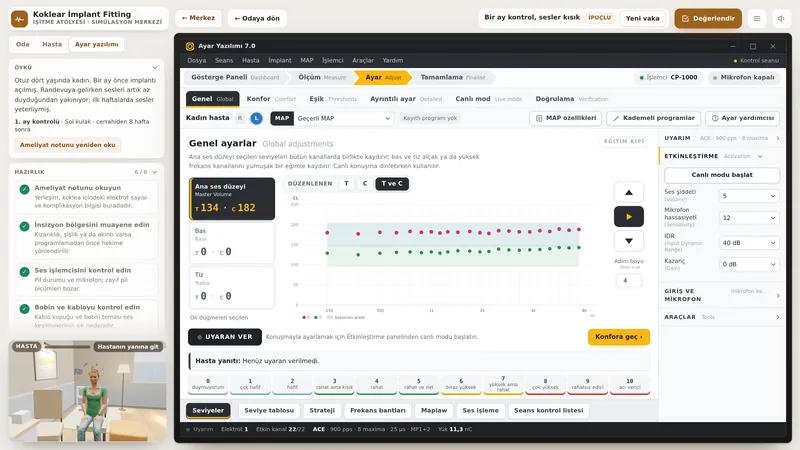
- T (threshold) and C (comfort) levels are set for each electrode.
- In infants and children who cannot give behavioural responses, objective measures such as ECAP and the electrically evoked stapedial reflex threshold (ESRT) are used.
- Live speech is checked and the programs are written to the sound processor.
- Use, care and daily wearing time are discussed.
How does programming progress?
The settings file created during programming is called a MAP. In the first months, C levels rise as the person adapts to electrical stimulation, which is why appointments are frequent. ECAP thresholds correlate only moderately with T and C levels (r = 0.58 and 0.61); objective measures guide programming but do not fully replace behavioural responses.
No difference in speech recognition has been found between remote and in-person programming (7 studies, 123 users).
First-year follow-up schedule
- Activation
- Week 1
- Month 1
- Month 3
- Month 6
- Month 12
- Every 6-12 months
- Activation
- Week 1
- Months 1-2
- Month 3
- Month 6
- Month 9
- Month 12
Daily wearing time matters. In 337 adults, longer daily use in the first month was associated with a higher chance of reaching target speech scores within the first year; wearing the processor during all waking hours, at least 12 hours a day, is recommended. Datalogging in the sound processor helps to monitor this.
You can program an implant with impedances, ECAP, T and C levels and loudness balancing in the Cochlear Implant Fitting Simulator.
Source: AAA (2019); Özbal Batuk et al. (2019); de Vos et al. (2018); Shah et al. (2025); Lindquist et al. (2023).
Rehabilitation and outcomes
The implant delivers sound; the brain learns to make sense of it. Regular use and auditory training are therefore an essential part of the outcome. For details see the Auditory Rehabilitation guide.
Adults
In a scoping review of 201 studies, the average word recognition score in the implanted ear was 8% before and 54% after implantation; sentence recognition was 74% in quiet and 50% in noise. 82% of postlingual and 53% of prelingual adults (hearing loss before language development) gained at least 15 points. Improvement is fastest in the first year and can continue for several years.
Factors associated with outcome include duration of hearing loss, age at implantation, age at onset, aetiology and implant experience; daily wearing time is also related to outcome. In 2,251 adults, these factors together explained only about 10% of the variability in outcome, so expectations are discussed individually.
Children
In the CDaCI study, which followed 188 children implanted before age 5, the rate of language development increased the younger the child was at implantation. After three years, the gap with hearing peers was smallest in children implanted before 18 months.
| Age at implantation | Comprehension | Expression |
|---|---|---|
| < 18 months | 8.1 | 8.2 |
| 18-36 months | 27.0 | 21.7 |
| 36-60 months | 38.7 | 29.4 |
In a Turkish study of 80 prelingual children, auditory perception scores increased significantly after surgery in every age group. In a multinational registry, more than half of children were in mainstream education without support after 3 years.
Hearing with two ears
Bilateral implants, or a hearing aid in the other ear (bimodal), improve speech understanding in noise through the head shadow effect and binaural summation. The average error in locating a sound source is 6° with normal hearing and 20-30° with bilateral implants, whereas with a single implant or bimodal use it is close to chance. In children, an interval of more than 1.5-2 years between the two implants can lead to lasting asymmetry in the auditory system.
Tinnitus, music and quality of life
- In bilateral hearing loss, tinnitus decreases after implantation in 25-72% of patients, and new tinnitus appears in 0-10%.
- Rhythm is perceived relatively well in music, while pitch, melody and timbre perception are limited.
- Some studies report improved cognitive test scores in older adults after implantation, but these studies had no control groups.
- In Turkish, quality of life of implant users can be assessed with the Turkish version of the Nijmegen Cochlear Implant Questionnaire (Tr-NCIQ), and music-related quality of life with the Turkish version of MuRQoL (study summary).
Source: Boisvert et al. (2020); Blamey et al. (2013); Lindquist et al. (2023); Niparko et al. (2010); Erken et al. (2020); Muller et al. (2023); Dorman et al. (2016); Kokkinakis and Pak (2014); Gordon, Jiwani and Papsin (2013); Ramakers et al. (2015); Limb and Roy (2014); Mosnier et al. (2015); Claes et al. (2018); Alnıaçık, Çakmak and Öz (2022); Akbulut et al. (2021).
Daily life with an implant
MRI scans
Most current implants are MR conditional at 1.5 tesla; some newer models allow 3 tesla scanning with the magnet in place. Older models may require magnet removal or a head bandage, and pain and magnet displacement during scanning have been reported with them. Tell the radiology department your implant model before the scan. The magnet causes an artefact on head images on the implanted side.
Other medical procedures
Monopolar electrosurgery, electroconvulsive therapy, neurostimulation and ionising radiation therapy to the head and neck are restricted. Consult your implant team before these procedures.
Static electricity
Static electricity from sources such as plastic slides, synthetic clothing and screens can damage the sound processor or its program. Removing the processor in these settings is recommended.
Water and bathing
Sound processors are not fully waterproof. Manufacturers offer waterproof covers and accessories for swimming and bathing.
Sports
A blow to the head can damage the internal part. A protective helmet should be worn for contact sports and activities such as cycling.
Travel
You can walk through airport security with the sound processor on. Carry your implant ID card, and keep a spare processor and batteries in your hand luggage.
Connectivity
Current sound processors can stream audio directly from phones and televisions and work with remote microphone systems. For school-age children, a remote microphone system is especially useful in the classroom.
Care and spare parts
A drying kit, regular checks of the cable and coil, and spare batteries keep the processor working reliably. Battery life depends on the battery type (about 10-35 hours for one manufacturer’s current processor). For replacement intervals in Türkiye see the SGK section.
Source: FDA, Benefits and Risks of Cochlear Implants; Cochlear, Advanced Bionics and MED-EL MRI safety pages; Kim et al. (2015); Cochlear Nucleus 8 technical specifications; AAA (2019).
Alternatives and related implants
A cochlear implant is not the right option for every hearing loss. The type and degree of hearing loss and the state of the cochlear nerve determine the choice.
Power hearing aids
Benefit is first assessed with appropriately fitted hearing aids; an implant is considered when hearing aids do not provide enough benefit.
Bone conduction devices
Used in conductive and mixed hearing loss and in single-sided deafness. Percutaneous and transcutaneous (passive or active) types exist. In the SUT they are listed as bone-anchored hearing devices; under age 5 they are used on a softband.
Active middle ear implants
An option in moderate to severe sensorineural loss for people who cannot use hearing aids, and in conductive and mixed loss.
Auditory brainstem implant
Stimulates the auditory pathway at the brainstem in cochlear nerve aplasia/hypoplasia, severe inner ear malformations without a developed cochlea and neurofibromatosis type 2. Long-term results in children in Türkiye have been reported from Hacettepe.
CROS
Routes sound from the side with no hearing to the better ear in single-sided deafness; it does not improve sound localisation.
Source: Reinfeldt et al. (2015); Koşaner Kließ et al. (2018); Sennaroğlu et al. (2016); Peters et al. (2021); SUT provisions on auditory implants (Official Gazette 26.11.2016, no. 29900; 16.03.2023, no. 32134 bis).
Frequently asked questions
No. A cochlear implant allows many people to understand speech in quiet, but speech in noise and music remain more difficult. Outcomes range from close to normal hearing to limited benefit.
No. There is no upper age limit; according to international consensus, age alone should not limit candidacy. In a large registry, an effect of age appeared only after age 70, and it was small.
One implant gives substantial benefit for speech understanding, but hearing with two ears is better for locating sounds and for understanding in noise. Where suitable, a hearing aid is used in the other ear (bimodal); for children, simultaneous bilateral implantation is recommended. In Türkiye, reimbursement of bilateral implants is limited to specific groups.
Most current implants are MR conditional at 1.5 tesla, and some newer models also allow 3 tesla. Conditions vary by model, so tell the radiology team your implant model before the scan.
No. It is ear surgery performed through the mastoid bone behind the ear, and it usually takes 1-3 hours.
No. Outcomes are better the shorter the duration of hearing loss. For candidates with residual hearing there are hearing preservation surgery and electric-acoustic stimulation options.
You may. Not having used hearing aids for a long time does not rule out benefit, although average gains are smaller with prelingual and very long-standing hearing loss. Expectations are discussed individually during the evaluation.
Yes. You can swim with waterproof accessories; a protective helmet should be worn for contact sports, because a blow to the head can damage the internal part.
Many can. In a multinational registry, more than half of children were in mainstream education without support after 3 years. The choice of school depends on the child’s language level and needs.
The internal part is long-lasting; in large series, 10-year implant survival is above 90%. If it fails, it is replaced in a new operation (reimplantation).
If you used this guide, you can cite it as follows (APA 7):
Auditory Scene. (2026). Cochlear Implant Guide (A. A. Akbulut, Ed.). Hearing Health Guides. https://auditoryscene.com/guides/koklear-implant/Editor: Ahmet Alperen Akbulut, MSc Audiology (Lecturer) · Permanent link: auditoryscene.com/guides/koklear-implant/ · Last reviewed: October 2026 · Licence: CC BY-NC-ND 4.0
Glossary
- Sound processor
- The external part that picks up sound, splits it into frequency bands and codes it. Called “speech processor” in the SUT.
- Coil
- The part that sends the signal and power from the sound processor across the skin to the internal part; held in place by a magnet.
- Internal part
- The body placed under the skin and the electrode array inserted into the cochlea.
- Electrode array
- The thin carrier inserted into the cochlea, with 12-22 electrodes.
- Activation
- The session after surgery in which the sound processor is fitted and programmed for the first time.
- MAP
- The settings file created during programming, containing the stimulation levels and parameters for each electrode.
- T and C levels
- For each electrode, the lowest perceived (threshold) and the highest comfortably accepted (comfort) stimulation levels.
- Impedance
- The electrical resistance of an electrode; shows whether there is a short or open circuit.
- ECAP
- Electrically evoked compound action potential recorded from the auditory nerve; an objective measure that guides programming.
- ESRT
- Electrically evoked stapedial reflex threshold; used to estimate C levels.
- Bimodal
- A cochlear implant in one ear and a hearing aid in the other.
- Electric-acoustic stimulation (EAS)
- Delivery of low frequencies acoustically and high frequencies electrically in the same ear.
- Residual hearing
- Measurable hearing that remains despite severe loss, usually at low frequencies.
- Simultaneous / sequential bilateral
- Implanting both ears in the same operation or in separate operations.
- Prelingual / postlingual
- Hearing loss that develops before or after language acquisition.
- ANSD
- Auditory neuropathy spectrum disorder: OAE or cochlear microphonic present with an abnormal or absent ABR.
- Auditory brainstem implant
- An implant that stimulates the cochlear nucleus in the brainstem when the cochlea or cochlear nerve cannot be used.
- Reimplantation
- Replacing a failed or problematic internal part in a new operation.
References
- Akbulut, A. A., Çiprut, A., Akdeniz, E., & Batman, Ç. (2022). Translation and validation of the music-related quality of life questionnaire for adults with cochlear implant in Turkish language. European Archives of Oto-Rhino-Laryngology, 279(2), 685-693. doi.org/10.1007/s00405-021-06693-w
- Alnıaçık, A., Çakmak, E., & Öz, O. (2022). Cross-cultural adaptation of the Nijmegen cochlear implant questionnaire into Turkish language. European Archives of Oto-Rhino-Laryngology, 279(4), 2175-2182. doi.org/10.1007/s00405-021-07191-9
- American Academy of Audiology. (2019). Clinical practice guideline: Cochlear implants. Journal of the American Academy of Audiology, 30(10), 827-844.
- Bernardes, M., Costa, C., Ramos, H., Almeida, R., Gobbo, D., Carasek, N., Bahmad, F., & Lamounier, P. (2024). Cochlear implantation in children with auditory neuropathy: Meta-analysis. Audiology and Neurotology, 29(3), 167-180. doi.org/10.1159/000533298
- Blamey, P., Artieres, F., Başkent, D., et al. (2013). Factors affecting auditory performance of postlinguistically deaf adults using cochlear implants: An update with 2251 patients. Audiology and Neurotology, 18(1), 36-47. doi.org/10.1159/000343189
- Boisvert, I., Reis, M., Au, A., Cowan, R., & Dowell, R. C. (2020). Cochlear implantation outcomes in adults: A scoping review. PLoS ONE, 15(5), e0232421. doi.org/10.1371/journal.pone.0232421
- Buchman, C. A., Gifford, R. H., Haynes, D. S., et al. (2020). Unilateral cochlear implants for severe, profound, or moderate sloping to profound bilateral sensorineural hearing loss: A systematic review and consensus statements. JAMA Otolaryngology-Head & Neck Surgery, 146(10), 942-953. doi.org/10.1001/jamaoto.2020.0998
- Çekiç, Ş., & Sennaroğlu, G. (2008). The Turkish hearing in noise test. International Journal of Audiology, 47(6), 366-368. doi.org/10.1080/14992020802056027
- Centers for Disease Control and Prevention. (2026). Pneumococcal vaccination for people with cochlear implants. www.cdc.gov/pneumococcal/vaccines/cochlear-implants.html
- Centers for Medicare & Medicaid Services. (2022). National coverage determination: Cochlear implantation (50.3). www.cms.gov/medicare-coverage-database/view/ncd.aspx?ncdid=245
- Claes, A. J., Van de Heyning, P., Gilles, A., Van Rompaey, V., & Mertens, G. (2018). Cognitive performance of severely hearing-impaired older adults before and after cochlear implantation. Otology & Neurotology, 39(9), e765-e773. doi.org/10.1097/MAO.0000000000001936
- Cooper, J., Mittal, J., Zalta, M., et al. (2025). Bridging the gap: A systematic review of intraoperative electrocochleography during cochlear implantation and preservation of residual hearing. PLoS ONE, 20(5), e0323493. doi.org/10.1371/journal.pone.0323493
- de Vos, J. J., Biesheuvel, J. D., Briaire, J. J., et al. (2018). Use of electrically evoked compound action potentials for cochlear implant fitting: A systematic review. Ear and Hearing, 39(3), 401-411. doi.org/10.1097/AUD.0000000000000495
- Dhanasingh, A., Nielsen, S. B., Beal, F., et al. (2024). Cochlear implant electrode design for safe and effective treatment. Frontiers in Neurology, 15, 1348439. doi.org/10.3389/fneur.2024.1348439
- Dorman, M. F., Loiselle, L. H., Cook, S. J., Yost, W. A., & Gifford, R. H. (2016). Sound source localization by normal-hearing listeners, hearing-impaired listeners and cochlear implant listeners. Audiology and Neurotology, 21(3), 127-131. doi.org/10.1159/000444740
- Erken, Ş. B., Barmak, E., Keseroğlu, K., & Korkmaz, M. H. (2020). İşitme kayıplı bireylerde koklear implantın işitsel algı test sonuçları üzerine etkisinin değerlendirilmesi. KBB-Forum, 19(3), 310-317. kbb-forum.net/journal/pdf.php?id=511
- Farinetti, A., Ben Gharbia, D., Mancini, J., Roman, S., Nicollas, R., & Triglia, J.-M. (2014). Cochlear implant complications in 403 patients. European Annals of Otorhinolaryngology, Head and Neck Diseases, 131(3), 177-182. doi.org/10.1016/j.anorl.2013.05.005
- Food and Drug Administration. (2021). Benefits and risks of cochlear implants. www.fda.gov/medical-devices/cochlear-implants/benefits-and-risks-cochlear-implants
- Gordon, K. A., Jiwani, S., & Papsin, B. C. (2013). Benefits and detriments of unilateral cochlear implant use on bilateral auditory development in children who are deaf. Frontiers in Psychology, 4, 719. doi.org/10.3389/fpsyg.2013.00719
- Güven, S., & Topbaş, S. (2014). Erken Dil Gelişimi Testi üçüncü versiyonu’nun (TELD-3) Türkçe’ye uyarlama, geçerlik ve güvenirlik ön çalışması. International Journal of Early Childhood Special Education, 6(2), 151-176. doi.org/10.20489/intjecse.62795
- İçöz, Ö. (2022). Çocuklar için İşitsel Algı Testi’nin geçerlik ve güvenirlik çalışması [Doctoral dissertation, Hacettepe University]. http://hdl.handle.net/11655/27127
- Karamert, R., Düzlü, M., Tutar, H., et al. (2019). Assessment of cochlear implant revision surgeries in a cohort of 802 patients. Otology & Neurotology, 40(4), 464-470. doi.org/10.1097/MAO.0000000000002152
- Kartal Özcan, E., Çekiç, Ş., Sennaroğlu, G., & Soli, S. D. (2023). Development of the Turkish hearing in noise test for children. Cochlear Implants International, 24(5), 235-242. doi.org/10.1080/14670100.2023.2179753
- Kim, B. G., Kim, J. W., Park, J. J., Kim, S. H., Kim, H. N., & Choi, J. Y. (2015). Adverse events and discomfort during magnetic resonance imaging in cochlear implant recipients. JAMA Otolaryngology-Head & Neck Surgery, 141(1), 45-52. doi.org/10.1001/jamaoto.2014.2926
- Kokkinakis, K., & Pak, N. (2014). Binaural advantages in users of bimodal and bilateral cochlear implant devices. The Journal of the Acoustical Society of America, 135(1), EL47-EL53. doi.org/10.1121/1.4831955
- Koşaner Kließ, M., Narayanan, A., et al. (2018). The use of active middle ear implants versus conventional hearing aids in mild to moderately severe hearing loss. Laryngoscope Investigative Otolaryngology, 3(5), 394-404. doi.org/10.1002/lio2.215
- Limb, C. J., & Roy, A. T. (2014). Technological, biological, and acoustical constraints to music perception in cochlear implant users. Hearing Research, 308, 13-26. doi.org/10.1016/j.heares.2013.04.009
- Lindquist, N. R., Dietrich, M. S., Patro, A., Henderson, L. W., DeFreese, A. J., Holder, J. T., Gifford, R. H., & Haynes, D. S. (2023). Early datalogging predicts cochlear implant performance: Building a recommendation for daily device usage. Otology & Neurotology, 44(7), e479-e485. doi.org/10.1097/MAO.0000000000003917
- Loizou, P. C. Introduction to cochlear implants. University of Texas at Dallas. ecs.utdallas.edu/loizou/cimplants/tutorial/tutorial.htm
- Mikkelsen, K. S., Ovesen, T., & Swan, C. Z. (2017). Pre- and post-operative dizziness, tinnitus, and taste disturbances among cochlear implant recipients. The Journal of Laryngology & Otology, 131(4), 309-315. doi.org/10.1017/S0022215116010008
- Mosnier, I., Bebear, J.-P., Marx, M., et al. (2015). Improvement of cognitive function after cochlear implantation in elderly patients. JAMA Otolaryngology-Head & Neck Surgery, 141(5), 442-450.
- Muller, L., Goh, B. S., Cordovés, A. P., et al. (2023). Longitudinal outcomes for educational placement and quality of life in a prospectively recruited multinational cohort of children with cochlear implants. International Journal of Pediatric Otorhinolaryngology, 170, 111583. doi.org/10.1016/j.ijporl.2023.111583
- National Institute for Health and Care Excellence. (2019). Cochlear implants for children and adults with severe to profound deafness (TA566). www.nice.org.uk/guidance/ta566
- National Institute on Deafness and Other Communication Disorders. (2016, updated 2021). Cochlear implants. www.nidcd.nih.gov/health/cochlear-implants
- Niparko, J. K., Tobey, E. A., Thal, D. J., et al. (2010). Spoken language development in children following cochlear implantation. JAMA, 303(15), 1498-1506. doi.org/10.1001/jama.2010.451
- Özbal Batuk, M., Yaralı, M., Çınar, B. Ç., Kocabay, A. P., Bajin, M. D., Sennaroğlu, G., & Sennaroğlu, L. (2019). Is early cochlear implant device activation safe for all on-the-ear and off-the-ear sound processors? Audiology and Neurotology, 24(6), 279-284. doi.org/10.1159/000503378
- Ozdemir, O., Yigit, O., Can, E., & Kalaycik Ertugay, C. (2022). Cochlear implant complications in a tertiary referral center in Istanbul. Audiology and Neurotology, 27(4), 321-327. doi.org/10.1159/000522281
- Öztürk, Ç. (2005). Koklear implant [Seminer notu]. Uludağ Üniversitesi Tıp Fakültesi Kulak Burun Boğaz Anabilim Dalı. http://kbb.uludag.edu.tr/seminer-koklearimplant.htm
- Parry, D. A., Booth, T., & Roland, P. S. (2005). Advantages of magnetic resonance imaging over computed tomography in preoperative evaluation of pediatric cochlear implant candidates. Otology & Neurotology, 26(5), 976-982. doi.org/10.1097/01.mao.0000185049.61770.da
- Peters, J. P. M., van Heteren, J. A. A., Wendrich, A. W., et al. (2021). Short-term outcomes of cochlear implantation for single-sided deafness compared to bone conduction devices and contralateral routing of sound hearing aids (CINGLE-trial). PLoS ONE, 16(10), e0257447. doi.org/10.1371/journal.pone.0257447
- Ramakers, G. G. J., van Zon, A., Stegeman, I., & Grolman, W. (2015). The effect of cochlear implantation on tinnitus in patients with bilateral hearing loss: A systematic review. The Laryngoscope, 125(11), 2584-2592. doi.org/10.1002/lary.25370
- Ramsden, J. D., Gordon, K., Aschendorff, A., Borucki, L., et al. (2012). European Bilateral Pediatric Cochlear Implant Forum consensus statement. Otology & Neurotology, 33(4), 561-565. doi.org/10.1097/MAO.0b013e3182536ae2
- Reinfeldt, S., Håkansson, B., Taghavi, H., & Eeg-Olofsson, M. (2015). New developments in bone-conduction hearing implants: A review. Medical Devices: Evidence and Research, 8, 79-93. doi.org/10.2147/MDER.S39691
- Roland, J. T., Jr., Gantz, B. J., Waltzman, S. B., Parkinson, A. J., & the Multicenter Clinical Trial Group. (2016). United States multicenter clinical trial of the Cochlear Nucleus Hybrid implant system. The Laryngoscope, 126(1), 175-181. doi.org/10.1002/lary.25451
- Sennaroğlu, L., & Bajin, M. D. (2017). Classification and current management of inner ear malformations. Balkan Medical Journal, 34(5), 397-411. doi.org/10.4274/balkanmedj.2017.0367
- Sennaroğlu, L., Sennaroğlu, G., Yücel, E., et al. (2016). Long-term results of ABI in children with severe inner ear malformations. Otology & Neurotology, 37(7), 865-872. doi.org/10.1097/MAO.0000000000001050
- Shah, A. H., McCray, L. R., Nguyen, S. A., Camposeo, E., & Dixon, P. R. (2025). Speech perception outcomes in cochlear implant users undergoing remote versus in-person programming: A systematic review and meta analysis. The Laryngoscope, 135(12), 4554-4563. doi.org/10.1002/lary.32355
- Sharma, A., Dorman, M. F., & Spahr, A. J. (2002). A sensitive period for the development of the central auditory system in children with cochlear implants. Ear and Hearing, 23(6), 532-539. doi.org/10.1097/00003446-200212000-00004
- Singhal, K., Singhal, J., Muzaffar, J., Monksfield, P., & Bance, M. (2020). Outcomes of cochlear implantation in patients with post-meningitis deafness: A systematic review and narrative synthesis. The Journal of International Advanced Otology, 16(3), 395-410. doi.org/10.5152/iao.2020.9040
- Song, B., Oh, S., Kim, D., Cho, Y. S., & Moon, I. J. (2024). Changes in revision cochlear implantation and device failure profiles. Clinical and Experimental Otorhinolaryngology, 17(1), 37-45. doi.org/10.21053/ceo.2023.00010
- Sosyal Güvenlik Kurumu. (2016, November 26). Sağlık Uygulama Tebliğinde değişiklik yapılmasına dair tebliğ [Communiqué amending the Health Implementation Communiqué]. Resmî Gazete, 29900. www.lexpera.com.tr/resmi-gazete/metin/sosyal-guvenlik-kurumu-saglik-uygulama-tebliginde-degisiklik-yapilmasina-dair-teblig-29900
- Sosyal Güvenlik Kurumu. (2023, March 16). Sağlık Uygulama Tebliğinde değişiklik yapılmasına dair tebliğ [Communiqué amending the Health Implementation Communiqué]. Resmî Gazete, 32134 (Mükerrer). sgk.gov.tr/Download/DownloadFile?f=9a2400c5-def6-4a79-9ecf-525770983bd3.pdf&d=fe4d32ca-c363-4f05-8136-7c48b628bfb0
- Terry, B., Kelt, R. E., & Jeyakumar, A. (2015). Delayed complications after cochlear implantation. JAMA Otolaryngology-Head & Neck Surgery, 141(11), 1012-1017. doi.org/10.1001/jamaoto.2015.2154
- Topsakal, V., Heuninck, E., Matulic, M., et al. (2022). First study in men evaluating a surgical robotic tool providing autonomous inner ear access for cochlear implantation. Frontiers in Neurology, 13, 804507. doi.org/10.3389/fneur.2022.804507
- Van de Heyning, P. H., Dazert, S., Gavilan, J., et al. (2022). Systematic literature review of hearing preservation rates in cochlear implantation associated with medium, longer, and longest electrode arrays. Frontiers in Surgery, 9, 893839. doi.org/10.3389/fsurg.2022.893839
- Wilson, B. S., & Dorman, M. F. (2008). Cochlear implants: A remarkable past and a brilliant future. Hearing Research, 242, 3-21. doi.org/10.1016/j.heares.2008.06.005
- Zeng, F.-G. (2022). Celebrating the one millionth cochlear implant. JASA Express Letters, 2(7), 077201. doi.org/10.1121/10.0012825
- Zokoll, M. A., Fidan, D., Türkyılmaz, D., et al. (2015). Development and evaluation of the Turkish matrix sentence test. International Journal of Audiology, 54(Suppl. 2), 51-61. doi.org/10.3109/14992027.2015.1074735
- Zwolan, T. A., Schvartz-Leyzac, K. C., & Pleasant, T. (2020). Development of a 60/60 guideline for referring adults for a traditional cochlear implant candidacy evaluation. Otology & Neurotology, 41(7), 895-900. doi.org/10.1097/MAO.0000000000002664
Try it in the simulator