 Auditory Scene
At a glance
Presbycusis is a bilateral, symmetrical sensorineural hearing loss caused by gradual age-related degeneration of inner-ear and auditory-nerve structures.
The commonest symptoms are difficulty following speech in noise, the complaint ‘I can hear but I can’t understand’, turning up the television and tinnitus.
It is not an emergency, but untreated hearing loss is associated with social isolation and cognitive decline.
Management rests on hearing aids and auditory rehabilitation, with a cochlear implant in suitable cases. Starting early improves outcomes.
Medical disclaimer. This content is for informational purposes only and does not replace a physician’s examination, diagnosis or treatment; it should not be used as medical advice. For your complaints or personal situation, always consult an ear, nose and throat physician and an audiologist.
If you find it hard to follow speech, especially in noisy places, often ask people to repeat themselves, turn up the television or notice tinnitus, see an audiologist. Not putting off hearing aids helps reduce the risk of social isolation, depression and cognitive decline.
Definition and epidemiology
Presbycusis is a bilateral, symmetrical sensorineural hearing loss that results from gradual age-related degeneration of the hair cells, the stria vascularis and auditory-nerve structures of the inner ear.
It is one of the commonest causes of hearing loss worldwide, and its prevalence rises steeply with age. According to the World Health Organization, moderate or worse hearing loss affects 12.7% of people at 60 years and more than 58% at 90 years (WHO, 2021).
Schuknecht’s classification, based on temporal bone findings, describes sensory (hair-cell loss), strial or metabolic, and neural (spiral ganglion loss) presbycusis; in most people these processes coexist (Wang and Puel, 2020).
Symptoms and signs
The commonest complaint is difficulty understanding speech, especially in noisy places. The person can hear that someone is talking but cannot make out the words, and often asks for repetition or turns up the television.
Because the loss typically begins at the high frequencies, consonants such as s, sh, f and t become hard to tell apart and speech sounds muffled rather than clear. Over time telephone calls and crowded settings become difficult, and the person may begin to avoid social situations.
Tinnitus often accompanies the loss. Because the onset is gradual and insidious, the person and their family usually notice it late.
Causes and risk factors
Presbycusis is multifactorial. Genetic predisposition, lifelong noise exposure, ototoxic drugs and metabolic and vascular factors act together (Gates and Mills, 2005; Wang and Puel, 2020).
Conditions that harm vascular health, such as hypertension, diabetes, obesity and smoking, increase the risk of hearing loss and are thought to speed up the process by impairing the microcirculation of the inner ear.
Controlling these risk factors matters for protecting both hearing and general health (Gates and Mills, 2005).
Audiological and clinical assessment
Assessment begins with an examination that excludes outer- and middle-ear causes. The diagnosis rests largely on audiological testing.
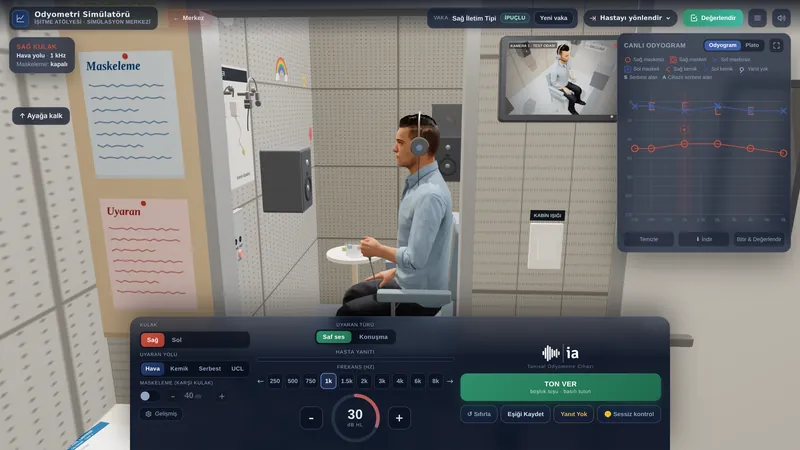
- Pure-tone audiometry: shows a bilateral, symmetrical sensorineural loss beginning at the high frequencies, with no air-bone gap.
- Speech audiometry and speech-in-noise tests: reveal the functional difficulty in everyday communication. Word recognition scores poorer than the pure-tone thresholds would predict suggest neural involvement (Gates and Mills, 2005).
- Tympanometry and acoustic reflexes: the tympanogram is usually normal (type A); these measures exclude middle-ear causes.
- OAE: assesses cochlear outer hair-cell function; responses are reduced or absent at the affected frequencies.
- Cognitive screening: may be recommended in older adults given the link between hearing and cognition.
Asymmetrical loss, unilateral tinnitus or rapid progression do not fit presbycusis; causes such as vestibular schwannoma and sudden hearing loss should be looked for.
Treatment and audiological rehabilitation
No drug reverses presbycusis; management rests on hearing aids and auditory rehabilitation. A hearing aid fitting based on the person’s audiogram and verified with real-ear measurement (REM) improves the intelligibility of speech.
People with severe or profound loss who gain too little from hearing aids are assessed for a cochlear implant; suitable candidates do well even at an advanced age.
Auditory rehabilitation is a multi-component process that includes device training, communication strategies, lip-reading and family involvement. In the ACHIEVE randomised controlled trial, hearing intervention did not significantly slow 3-year cognitive decline in the whole sample, but it was associated with slower decline in the subgroup at higher risk of cognitive decline (Lin et al., 2023).
Impact on quality of life and advice
Untreated hearing loss is associated with social isolation, depression, falls and cognitive decline. The 2024 Lancet Commission named hearing loss, together with high LDL cholesterol, as the modifiable factor contributing most to dementia risk, with a share of 7% (Livingston et al., 2024).
Recommended steps include not delaying hearing aids, reducing background noise, speaking face to face and clearly, and involving family members in conversation. Early intervention protects both communication and overall quality of life.
If you used this review, you can cite it as follows (APA 7):
Auditory Scene. (2026). Presbycusis (Age-Related Hearing Loss). Hearing & Balance Health Guide. https://auditoryscene.com/guncel-haberler/categories/isitme-sagligi-rehberi/presbiakuzi/Permanent link: auditoryscene.com/guncel-haberler/categories/isitme-sagligi-rehberi/presbiakuzi/ · Last reviewed: October 2026 · License: CC BY-NC-ND 4.0
References
- Gates, G. A., & Mills, J. H. (2005). Presbycusis. The Lancet, 366(9491), 1111-1120.
- Lin, F. R., Pike, J. R., Albert, M. S., et al. (2023). Hearing intervention versus health education control to reduce cognitive decline in older adults with hearing loss in the USA (ACHIEVE): A multicentre, randomised controlled trial. The Lancet, 402(10404), 786-797.
- Livingston, G., Huntley, J., Liu, K. Y., et al. (2024). Dementia prevention, intervention, and care: 2024 report of the Lancet standing Commission. The Lancet, 404(10452), 572-628.
- Wang, J., & Puel, J.-L. (2020). Presbycusis: An update on cochlear mechanisms and therapies. Journal of Clinical Medicine, 9(1), 218.
- World Health Organization. (2021). World report on hearing. WHO.
Frequently asked questions
What happens if I don’t use a hearing aid?
Untreated hearing loss makes communication harder over time and has been associated with social isolation, depression, falls and cognitive decline. A hearing aid helps reduce these risks, so it is best not to put it off.
Does a hearing aid prevent dementia?
It cannot be said that hearing aids definitely prevent dementia. However, current studies suggest that treating hearing loss may help slow cognitive decline, particularly in people at higher risk. Supporting hearing reduces listening effort and makes it easier to keep up social contact.
Why don’t I fully understand even with the device on?
A hearing aid makes sound louder, but how clearly speech is understood also depends on the brain’s capacity to process it. That is why communication strategies and auditory rehabilitation alongside the device clearly improve understanding. A careful fitting, with settings verified by real-ear measurement, is also very important.
Do blood pressure and blood sugar affect hearing?
Yes. High blood pressure and diabetes can increase the risk of hearing loss by impairing the inner ear’s microcirculation. Keeping these conditions under control helps protect both your general health and your hearing.
Will my hearing loss progress?
Presbycusis usually progresses slowly over the years. Regular hearing checks and updated device settings will help you keep communicating well.
Scales that can be used to monitor hearing handicap, hearing-aid benefit and daily impact: