 Auditory Scene
At a glance
Demyelinating lesions in the brainstem can affect auditory and vestibular pathways, causing sudden hearing loss, vertigo, imbalance and difficulty understanding speech in noise.
Sudden hearing loss or tinnitus in one ear, spinning vertigo, double vision, unsteady gait and difficulty following conversation in busy places.
Sudden hearing loss and new continuous vertigo need prompt assessment; brief positional vertigo, however, is often BPPV and may settle with a manoeuvre, without relapse treatment.
Managed jointly with neurology: audiological monitoring, repositioning for BPPV, vestibular rehabilitation and planning around fatigue.
Medical disclaimer. This content is for informational purposes only and does not replace a physician’s examination, diagnosis or treatment; it should not be used as medical advice. For your complaints or personal situation, always consult an ear, nose and throat physician and an audiologist.
If you notice sudden hearing loss in one ear, see an ear, nose and throat doctor the same day or within a few days, and mention that you have MS. If dizziness comes with double vision, slurred speech, or numbness or weakness in the face or one side of the body, seek emergency care. If you only get dizziness lasting seconds when lying down or turning your head, tell your neurologist and audiologist; this is often BPPV, which is easy to treat.
Definition and epidemiology
Multiple sclerosis (MS) is a chronic immune-mediated disease, usually beginning in young adulthood, in which myelin and axons in the central nervous system are damaged. When lesions lie in the brainstem, cerebellum or regions carrying the auditory pathways, hearing and balance symptoms appear. This article does not cover MS itself but the hearing and balance findings that audiologists and ENT doctors encounter.
Hearing and balance problems are reported more often than many clinicians expect. Across studies included in a systematic review, 25% of patients had sensorineural hearing loss; sudden sensorineural hearing loss occurred early in the disease in 92% of cases and was the only presenting symptom in 43% of female patients (Di Stadio, Dipietro, Ralli, Meneghello et al., 2018). Because 29 of the 47 publications in that review were case reports, the true frequency of sudden hearing loss as the first sign of MS is unknown; it accounts for only a small share of people presenting with sudden hearing loss. In another review pooling VEMP studies, 37% of patients reported vertigo (Di Stadio, Dipietro, Ralli, Greco et al., 2018).
Symptoms and signs
Sudden sensorineural hearing loss usually develops in one ear over hours or a few days, and tinnitus and aural fullness may accompany it. In the reviewed cases, sudden loss mostly occurred early in the disease, whereas slowly progressive sensorineural loss appeared late in the disease in 88% of patients (Di Stadio, Dipietro, Ralli, Meneghello et al., 2018). Even people with MS who have normal hearing thresholds can show measurable difficulty understanding speech in noisy, multi-talker settings (Iva et al., 2020).
Balance symptoms may take the form of spinning vertigo, persistent unsteadiness, oscillopsia on movement and walking difficulty. A lesion of the medial longitudinal fasciculus in the brainstem causes internuclear ophthalmoplegia: on lateral gaze one eye fails to adduct, the abducting eye shows nystagmus, and the person may report double vision. When this sign accompanies vertigo in MS, it strongly suggests a central origin. On the other hand, not every episode of vertigo in someone with MS is a relapse: vertigo lasting seconds and triggered by lying down, rolling over or tipping the head back is most often BPPV (Frohman et al., 2003). Fatigue is one of the commonest and most limiting symptoms of MS and can make balance complaints worse (Hebert et al., 2011).
Causes and risk factors
In MS, immune cells target myelin in the central nervous system. Loss of myelin slows conduction, causes conduction block and disrupts the synchronous firing of fibres. The auditory pathway runs in the brainstem from the cochlear nuclei through the superior olivary complex and lateral lemniscus to the inferior colliculus; plaques in these areas cause ABR latency prolongation and wave loss, and impair temporal and binaural processing. In sudden hearing loss, lesions at the root entry zone of the eighth nerve or at the level of the cochlear nucleus are held responsible, and microglia-mediated damage to central and/or peripheral auditory pathways has been proposed as a mechanism (Di Stadio, Dipietro, Ralli, Meneghello et al., 2018).
Vertigo most often arises from lesions involving the vestibular nuclei, the eighth nerve root entry zone and cerebellar connections. According to a VEMP review, central vestibular pathways are mainly affected early in the disease and the peripheral vestibular system mainly in later stages (Di Stadio, Dipietro, Ralli, Greco et al., 2018). In a study of vertigo in MS, BPPV was found in 52% of the sample (Frohman et al., 2003). Why BPPV is common in MS is not certain; reduced mobility, falls and repeated examinations have been discussed. Whatever the reason, a diagnosis of MS does not rule out BPPV.
Audiological and clinical assessment
When a person with MS has a hearing or balance complaint, the aim is to tell whether it comes from a new demyelinating lesion, a peripheral cause (such as BPPV, wax or age-related loss) or factors such as medication and fatigue. Assessment is planned together with neurology; MRI shows lesion location but may miss small lesions.
- Pure-tone and speech audiometry: sudden loss is usually unilateral and of variable degree, and thresholds may recover partly or fully. Word recognition poorer than the thresholds predict suggests retrocochlear involvement. For the audiogram and treatment pathway in sudden loss, see sudden hearing loss.
- Speech-in-noise tests: performance in multi-talker babble is reduced even with normal thresholds; word tests in babble distinguished mild MS from healthy controls with 80% sensitivity and 85% specificity (Iva et al., 2020). In Türkiye, 32 people with MS performed significantly worse than controls on the Turkish matrix sentence test in noise (Gedik Toker et al., 2024).
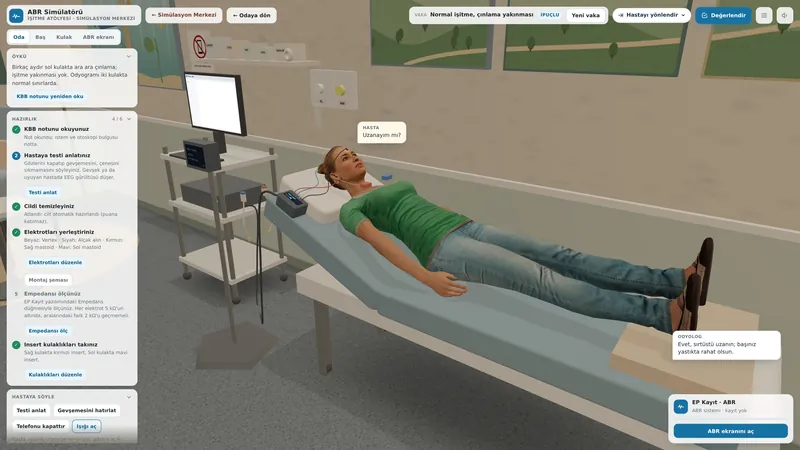
- ABR: prolonged I-V and III-V interpeak latencies, reduced wave V amplitude or absent waves indicate brainstem involvement. ABR was abnormal in all MS patients with sudden hearing loss and stayed abnormal after hearing recovered (Di Stadio, Dipietro, Ralli, Meneghello et al., 2018).
- OAEs: because the inner ear is usually intact, present OAEs together with an abnormal ABR support a retrocochlear lesion.
- Acoustic reflexes: since the reflex arc passes through the brainstem, loss of contralateral responses with preserved ipsilateral responses, or raised reflex thresholds, may point to a brainstem lesion; the finding should be interpreted alongside the audiogram.
- Central auditory processing tests: dichotic listening, temporal processing and speech-in-noise tests help document everyday difficulty; fatigue and cognitive involvement should be considered when interpreting them (Iva et al., 2020). See auditory processing disorder for details.
- Vestibular tests: oculomotor testing (saccades, smooth pursuit, gaze-evoked nystagmus) reveals central signs such as internuclear ophthalmoplegia. In the VEMP review, VEMPs were abnormal in 71% of patients, and 35.4% of those with abnormal VEMPs had a normal MRI (Di Stadio, Dipietro, Ralli, Greco et al., 2018). Dix-Hallpike and supine roll tests should be done in every person with MS and vertigo.
| Feature | BPPV | Brainstem or cerebellar lesion |
|---|---|---|
| Duration | Seconds; recurs with position | Continuous for days to weeks |
| Trigger | Lying down, rolling over, tipping head back | No clear trigger |
| Nystagmus | Positional, canal-specific pattern | Spontaneous, direction-changing or vertical |
| Other signs | None | Double vision, internuclear ophthalmoplegia, ataxia |
| Approach | Repositioning manoeuvre | Neurological assessment and MRI |
Acute continuous vertigo, direction-changing or vertical nystagmus, spontaneous nystagmus with a normal head impulse test, and accompanying neurological signs suggest a central lesion; these are described in central vertigo. Brief positional vertigo with typical positional nystagmus indicates BPPV. The differential diagnosis also includes vestibular neuritis, vestibular migraine, medication side effects and, in sudden hearing loss, vestibular schwannoma.
Treatment and audiological rehabilitation
Treatment of MS and its relapses rests with the neurologist, who plans steroids during relapses and disease-modifying therapy. Treatment of sudden hearing loss is decided jointly by ENT and neurology. The audiologist’s role is to document thresholds and ABR before and after treatment, monitor recovery and plan rehabilitation for any persistent loss.
If BPPV is found in a person with MS and vertigo, a repositioning manoeuvre is used. In the study by Frohman et al. (2000), all MS patients with BPPV recovered with the Epley manoeuvre. Vertigo should therefore not be treated as a relapse with steroids or vestibular suppressants before positional testing has been done. Vestibular rehabilitation is recommended for persistent imbalance: in a randomised controlled trial of 38 patients, a six-week vestibular rehabilitation programme produced greater improvement in fatigue, balance and dizziness-related disability than exercise or waiting-list control, and gains were maintained at four-week follow-up (Hebert et al., 2011). The programme should be adjusted to the person’s fatigue and heat sensitivity, with short, frequent sessions.
For persistent hearing loss, hearing aids are fitted; if understanding speech in noise is a major difficulty, remote microphone systems, communication strategies and changes to the listening environment are added. People who report everyday listening difficulty despite normal thresholds should be referred for central auditory assessment. When a new hearing or balance complaint arises, tests should be repeated and compared with earlier results.
Impact on quality of life and advice
In MS, hearing and balance problems combine with fatigue, visual disturbance and cognitive involvement to make communication and daily life harder. Following conversation in noisy meetings or crowded places demands extra listening effort and can increase fatigue. Balance problems may lead to fear of falling and avoidance of activities. The fluctuating course can make symptoms hard for others to understand.
Practical advice: schedule important conversations for times of day when you are less tired, and choose a quiet place where you can see the speaker’s face. Take short breaks in noisy settings. Seek help promptly if your hearing changes suddenly. If you have brief dizziness when lying down or turning over, be sure to mention it; it often settles with a simple manoeuvre. Reduce fall hazards at home and do your balance exercises regularly, bearing in mind that hot environments can make symptoms worse.
If you used this review, you can cite it as follows (APA 7):
Auditory Scene. (2026). Hearing and Balance in Multiple Sclerosis. Hearing & Balance Health Guide. https://auditoryscene.com/guncel-haberler/categories/isitme-sagligi-rehberi/multipl-sklerozda-isitme-ve-denge/Permanent link: auditoryscene.com/guncel-haberler/categories/isitme-sagligi-rehberi/multipl-sklerozda-isitme-ve-denge/ · Last reviewed: October 2026 · License: CC BY-NC-ND 4.0
References
- Di Stadio, A., Dipietro, L., Ralli, M., Greco, A., et al. (2018). The role of vestibular evoked myogenic potentials in multiple sclerosis-related vertigo. A systematic review of the literature. Multiple Sclerosis and Related Disorders, 28, 159-164.
- Di Stadio, A., Dipietro, L., Ralli, M., Meneghello, F., et al. (2018). Sudden hearing loss as an early detector of multiple sclerosis: A systematic review. European Review for Medical and Pharmacological Sciences, 22(14), 4611-4624.
- Frohman, E. M., Kramer, P. D., Dewey, R. B., et al. (2003). Benign paroxysmal positioning vertigo in multiple sclerosis: Diagnosis, pathophysiology and therapeutic techniques. Multiple Sclerosis, 9, 250-255.
- Frohman, E. M., Zhang, H., Dewey, R. B., et al. (2000). Vertigo in MS: Utility of positional and particle repositioning maneuvers. Neurology, 55(10), 1566-1569.
- Gedik Toker, Ö., Kuru, E., Tas Elibol, N., et al. (2024). Spectral resolution and speech comprehension performance in noise in individuals with multiple sclerosis. XII. Uluslararası Katılımlı Odyoloji ve Konuşma Bozuklukları Kongresi (pp. 110-111), Ankara.
- Hebert, J. R., Corboy, J. R., Manago, M. M., et al. (2011). Effects of vestibular rehabilitation on multiple sclerosis-related fatigue and upright postural control: A randomized controlled trial. Physical Therapy, 91(8), 1166-1183.
- Iva, P., Fielding, J., Clough, M., et al. (2020). Speech discrimination tasks: A sensitive sensory and cognitive measure in early and mild multiple sclerosis. Frontiers in Neuroscience, 14, 604991.
Frequently asked questions
Can sudden hearing loss be the first sign of MS?
Yes, but this is uncommon. Most sudden hearing loss has causes other than MS. In sudden loss due to MS, brainstem lesions may be seen on MRI and the ABR is usually abnormal. Your doctor will request an MRI if it is needed.
Does hearing loss caused by MS recover?
Some sudden losses recover partly or fully, either spontaneously or with treatment. Even when thresholds recover, however, the ABR may remain abnormal and difficulty understanding speech in noise may persist.
I have MS. Is every bout of dizziness a relapse?
No. BPPV is also common in people with MS. Dizziness lasting seconds when you lie down or turn over is often BPPV and settles with a simple manoeuvre. Positional tests should therefore be done first.
My hearing test is normal, but I cannot follow conversations in crowds. Why?
MS can affect the auditory pathways in the brainstem and brain, so understanding speech in noise becomes harder even when thresholds are normal. Speech-in-noise tests and a central auditory assessment can document this difficulty.
Will vestibular rehabilitation make my fatigue worse?
The programme should be adjusted to your fatigue. In a randomised trial, six weeks of vestibular rehabilitation improved balance and also reduced MS-related fatigue. Keeping sessions short and taking rest breaks helps.
How often should I have my hearing tested?
There is no set schedule. Have a test when a new hearing or balance problem, tinnitus or aural fullness appears, and keep your reports so that results can be compared over time.
The tools below can be used to assess the impact of dizziness, speech understanding in noise and listening-related fatigue.