The module was developed for adults whose audiograms are within normal limits but who struggle to understand speech in noise. The first peer-reviewed paper on the module reports no difference in laboratory speech tests in the final study, but most participants preferred the module in noisy places.
This article covers the study "Fitting hearing aids beyond the audiogram: the NAL-NL3 Minimal Hearing Loss Module" by Pádraig T. Kitterick, Justin A. Zakis and colleagues, published in the International Journal of Audiology in November 2026. It is the first peer-reviewed paper describing how the team at the National Acoustic Laboratories (NAL) in Australia developed and tested the module, and it appears in the journal's special supplement on the NAL-NL3 fitting system. Preliminary results were presented at the AAA, Audiology Australia and EUHA meetings in 2025.
Read the full paperInternational Journal of Audiology · Open accessGo to paper →An estimated 5-15% of patients seen in audiology clinics report listening difficulties despite a normal audiogram. Over the years this presentation has been described under different names, including King-Kopetzky syndrome and hidden hearing loss.
No. In pediatric audiology, the term minimal hearing loss usually follows the definition of Bess and colleagues (1998). It covers unilateral losses, bilateral losses averaging 20-40 dB HL, and high-frequency losses exceeding 25 dB HL at two or more frequencies above 2 kHz. The module discussed here was developed for adults and is based on the definition below.
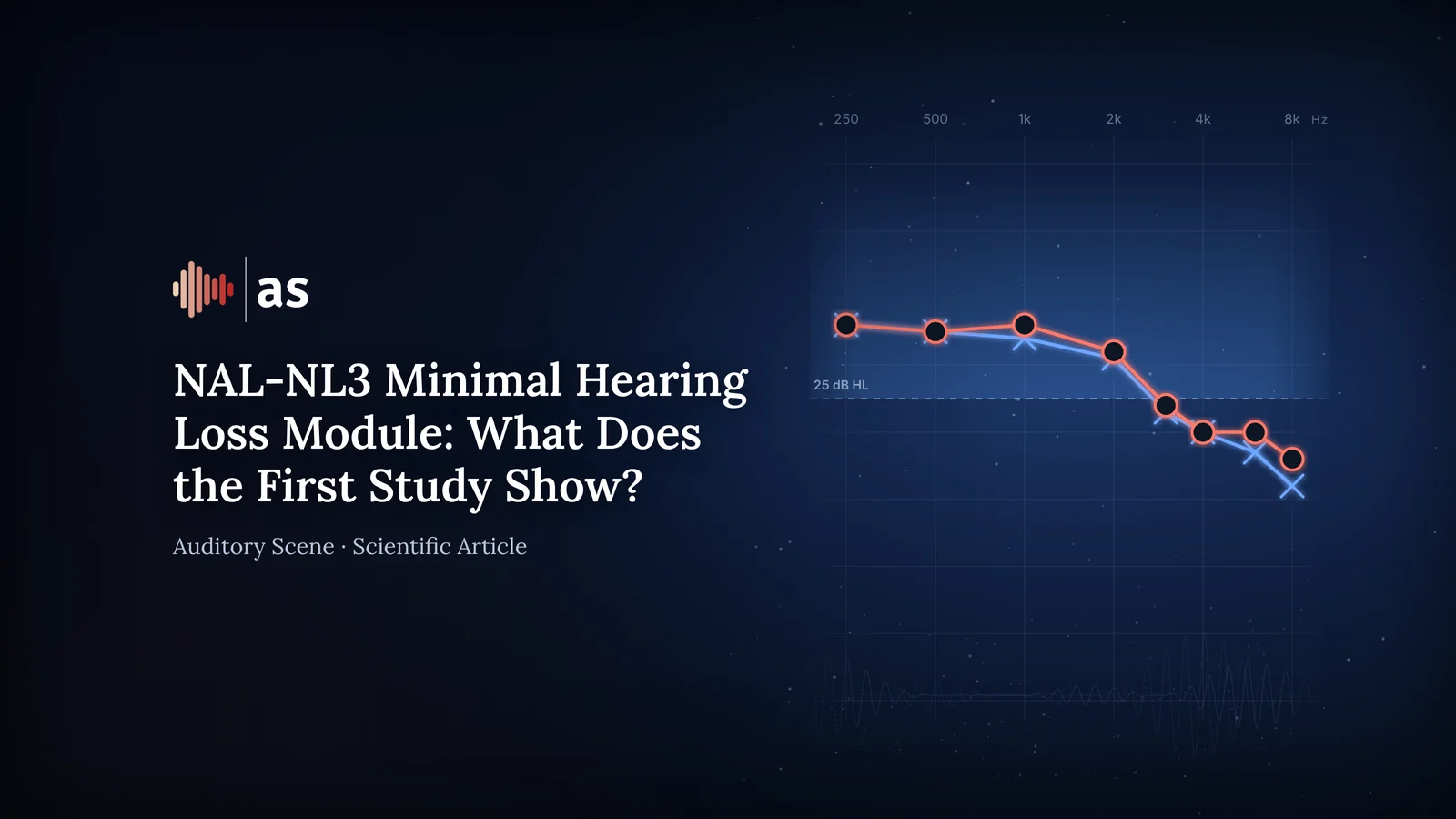
In the paper, minimal hearing loss requires two conditions. The person reports difficulty understanding speech in noise, and the four-frequency average (0.5, 1, 2 and 4 kHz) is 25 dB HL or better. This range is split in two. An average below 16 dB HL is considered a normal audiogram, and an average of 16-25 dB HL a slight hearing loss. These limits match the ASHA classification (Clark, 1981); in reports that use 25 dB HL as the upper limit of normal, all of these people may be described as having normal hearing. Even when the four-frequency average is within normal limits, high-frequency thresholds may be raised. In the mean audiogram of the final study, thresholds rose from 3 kHz upward and reached about 30-40 dB HL at 4-8 kHz.
Fitting formulas such as NAL-NL2 were designed to make speech sounds audible again when raised thresholds have made them inaudible. When thresholds are within normal limits, speech is already audible, so these formulas prescribe almost no insertion gain, the increase in sound level in the ear canal with the hearing aid in place compared with the open ear. The main complaint of these listeners, however, is difficulty picking out speech in noise.
The directional microphones and noise reduction algorithms of modern hearing aids improve the signal-to-noise ratio (SNR) of the sound the hearing aid processes. But the hearing aid is not the only source of sound at the eardrum. Sound that enters the ear canal around the dome or through the vent, without being processed by the hearing aid, also reaches the eardrum. This is called vent/dome leakage, or the direct path. When the hearing aid provides almost no gain, the two sounds mix at similar levels and most of the SNR improvement is lost. The module therefore provides a small positive gain, just enough for the aided sound to dominate the leaked sound.
The team developed the module over four consecutive studies, using the results of each to refine the next. In all studies, the hearing aids were fitted with the most occluding dome and with directional microphones and noise reduction switched on, and targets were verified with real-ear measurements.
In the second study, both prototypes made speech clearer and easier to understand than the standard formula, and laboratory speech scores were significantly higher with the 3 dB prototype. On the other hand, participants found the standard formula more comfortable and less annoying, and judged their own voice to sound more natural with it. There was no clear overall preference. The team also noticed that in very loud noise the hearing aid's output limit was clipping speech peaks.
In the final version, the minimum gain was kept at around 3 dB on average, on the assumption that users can raise it with the volume control when needed. Measurements with closed domes from different manufacturers showed that at least 4 dB of insertion gain is needed around 1 kHz for the aided sound to be at least 3 dB stronger than the leaked sound. Very little gain is prescribed below 1 kHz, because domes do little to block leakage at these frequencies and some devices struggled to deliver gain there.
For flat audiograms up to 15 dB HL, gain is linear; from 20 dB HL, gain increases as input level falls. The module prescribes whichever is higher: its own gain or the gain from the standard NAL-NL3 formula. This means that someone with a high-frequency loss also receives the gain needed at those frequencies. A new method was also defined for maximum power output (MPO). It sets the MPO so that speech peaks are not clipped in noisy places, while staying within safe sound levels even for 7-8 hours of exposure.
The final study included 29 adults with a mean age of 61. In the better ear, the four-frequency average was below 16 dB HL in 10 participants and 16-25 dB HL in 15; 4 participants measured 26-30 dB HL during the study but were kept in. Despite near-normal thresholds, many participants reported high levels of listening fatigue and hearing difficulty.
In laboratory speech tests in babble and café noise, there was no significant difference between the module and the standard formula. Participants then used both programs for two weeks without knowing which was which, and submitted ecological momentary assessments (EMA) through a smartphone app during the day. Of the 23 participants who submitted ratings in places at or above 75 dBA, 14 chose the module as their overall preference, 5 chose the standard formula and 4 saw no difference. The results were the same for the question on which program made speech easiest to understand.
Not every question favored the module. For comfortable loudness, participants more often chose the standard formula, and for the naturalness of their own voice, most saw no difference. The hearing aids were used for an average of 3 hours a day, in line with the module's design for use in noisy places. Two participants reported that their tinnitus seemed more noticeable with the hearing aids, and some said that sudden loud sounds bothered them and that they lowered their voice when talking with the hearing aids on.
The authors recommend closed domes for patients who may have a normal audiogram. In usual practice, an open dome is often considered sufficient for high-frequency losses and is preferred so that patients hear their own voice naturally. With the module, however, the aim is to improve the SNR at the eardrum across as wide a frequency range as possible. An open or vented dome increases leakage, narrows this range and may reduce the expected benefit in noise.
The authors also recommend choosing hearing aids that can genuinely improve the SNR, explaining that the hearing aids are meant for use in noisy places, and leaving the volume control enabled. Patients should be told that turning the volume down may improve comfort but also reduces the SNR benefit. Tinnitus should be asked about in the case history and monitored after fitting. Removing the hearing aids in dangerous situations such as traffic, and the fact that not everyone will benefit, should also be discussed from the start. Detailed clinical recommendations are given in a clinical note in the same supplement (Croteau and Kwok, 2026).
The study offers a data-driven fitting option for patients whose audiograms are within normal limits but who struggle in noise. Which patients benefit from the module, and how much it is used in the long term, will become clearer with larger, multicenter studies.
Note: The authors are employees of the National Acoustic Laboratories, which licenses the NAL-NL3 fitting system; according to the paper's disclosure statement, some authors may receive bonus payments from licensing revenue. The hearing aids used in the studies were provided by five major manufacturers. The paper is open access.
Kitterick, P. T., Zakis, J. A., Croteau, M., Boothalingam, S., Monaghan, J. J. M., Gavrilis, J., Mishra, D., Kwok, C., Wong, A., Hou, S., Meng, Q., Zhang, V. W., Easwar, V., Bennett, R. J., O'Keeffe, I. A., Marnane, V., De Luca Bamber, J., Olencewicz, G., Young, T., . . . Edwards, B. (2026). Fitting hearing aids beyond the audiogram: the NAL-NL3 Minimal Hearing Loss Module. International Journal of Audiology. https://doi.org/10.1080/14992027.2026.2758956
Bess, F. H., Dodd-Murphy, J., & Parker, R. A. (1998). Children with minimal sensorineural hearing loss: prevalence, educational performance, and functional status. Ear and Hearing, 19(5), 339-354.
Clark, J. G. (1981). Uses and abuses of hearing loss classification. Asha, 23(7), 493-500.
 Auditory Scene