 Auditory Scene
At a glance
A sudden-onset inflammation of the middle-ear mucosa, usually following an upper respiratory tract infection.
Ear pain (otalgia), fever, irritability, ear tugging and reduced hearing are the commonest features; if the eardrum perforates, the ear discharges.
Febrile infants under 3 months, children who are systemically unwell and those with signs of complications need prompt assessment.
Pain is treated in every case; suitable children are observed for 48-72 hours and antibiotics are started if needed.
Medical disclaimer. This content is for informational purposes only and does not replace a physician’s examination, diagnosis or treatment; it should not be used as medical advice. For your complaints or personal situation, always consult an ear, nose and throat physician and an audiologist.
See a doctor if your baby is under 3 months and has a fever, if your child seems generally unwell, if symptoms have not eased within 48-72 hours, or if the ear starts to discharge (otorrhoea). Dizziness, facial weakness, swelling and redness behind the ear, severe headache or neck stiffness need emergency assessment.
Definition and epidemiology
Acute otitis media (AOM) is a sudden-onset inflammation of the middle-ear mucosa. Diagnosis requires both a middle-ear effusion and signs of inflammation of the eardrum; fluid that remains after the inflammation has settled is followed up as otitis media with effusion.
It peaks between 6 months and 2 years of age (Lieberthal et al., 2013). In a cohort followed in the pneumococcal vaccine era, 60% of children had at least one episode by age 3 and 24% had three or more (Kaur et al., 2017). In young children the Eustachian tube is shorter and more horizontal, making it easier for nasopharyngeal organisms to reach the middle ear.
Symptoms and signs
In infants and toddlers the symptoms are non-specific: irritability, ear tugging, disturbed sleep and feeding, and fever. Older children can describe ear pain (otalgia) and dulled hearing themselves.
If the eardrum perforates, the pain often eases suddenly and purulent discharge appears. Mastoiditis, facial palsy and labyrinthitis are rare but serious complications; in a febrile infant under 3 months, systemic infection is also looked for.
Causes and risk factors
The commonest bacterial pathogens are Streptococcus pneumoniae, non-typeable Haemophilus influenzae and Moraxella catarrhalis; viral upper respiratory infections trigger many episodes. Pneumococcal conjugate vaccines have reduced disease caused by vaccine serotypes, but non-vaccine serotypes still cause AOM (Kaur et al., 2017).
Nursery attendance, tobacco smoke, lack of breastfeeding, bottle-feeding while lying down and dummy use increase the risk. Conditions that impair Eustachian tube function, such as cleft palate and Down syndrome, predispose to recurrent episodes.
Audiological and clinical assessment
Diagnosis is made by otoscopy. Moderate or severe bulging of the eardrum, or new-onset otorrhoea not caused by otitis externa, is diagnostic; mild bulging supports the diagnosis when combined with ear pain of less than 48 hours or intense redness. AOM should not be diagnosed without a middle-ear effusion, and redness alone is not enough (Lieberthal et al., 2013).
- Pneumatic otoscopy: confirms the effusion by showing reduced drum mobility.
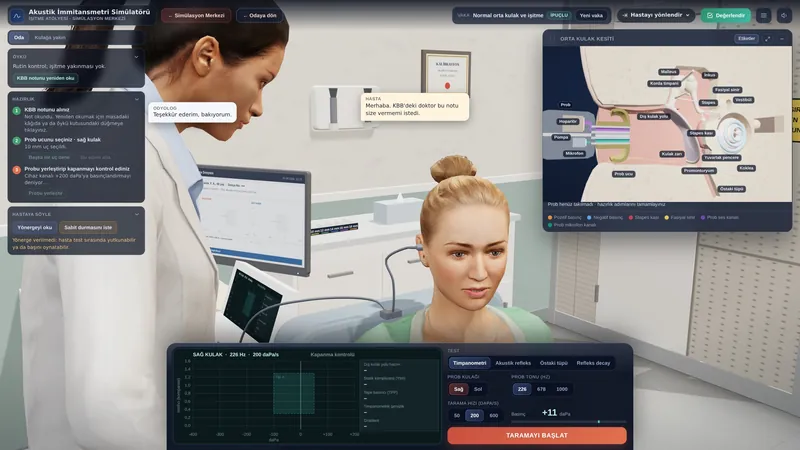
- Tympanometry: a flat (Type B) trace with a normal ear-canal volume; a perforation gives a high volume.
- Probe tone: a 1000 Hz probe tone is recommended under 6 months of age; at this age a 226 Hz trace can look misleadingly normal (Rosenfeld et al., 2016).
- Acoustic reflexes and OAEs: usually absent while fluid is present.
- Hearing assessment: not routine in the acute phase; an age-appropriate hearing test is done if the effusion persists for 3 months or longer (Rosenfeld et al., 2022).
A conductive loss found during the acute phase should be re-measured once the inflammation has resolved.
Treatment and audiological rehabilitation
Pain relief (paracetamol or ibuprofen) is the first step for every child. According to the current Cochrane review, antibiotics do not reduce pain in the first 24 hours and reduce the number of children still in pain at 2-3 days by about a third, but cause vomiting, diarrhoea or a rash in one child in 14 (Venekamp et al., 2023).
In children without severe features (moderate or severe pain, pain for more than 48 hours, temperature of 39 °C or above), watchful waiting is an option if review within 48-72 hours can be arranged: for unilateral AOM at 6-23 months, and for unilateral or bilateral AOM from 24 months. When an antibiotic is needed, amoxicillin is usually the first choice (Lieberthal et al., 2013); the decision and dosing rest with the doctor.
In recurrent AOM (three episodes in 6 months or four in 12 months), ventilation tubes (grommets) are recommended if middle-ear fluid is present at the time of assessment, and not if it is absent (Rosenfeld et al., 2022).
Impact on quality of life and advice
Frequent episodes can disturb a child’s sleep and feeding and the family’s routine. Persistent middle-ear fluid causes fluctuating hearing; speaking to the child face to face in a quiet room makes listening easier.
Keeping vaccinations up to date, including pneumococcal and annual influenza vaccines, and avoiding tobacco smoke reduce episodes (Lieberthal et al., 2013). Come back if pain and fever have not settled within 48-72 hours, if discharge starts, or if reduced hearing persists after recovery.
If you used this review, you can cite it as follows (APA 7):
Auditory Scene. (2026). Acute Otitis Media. Hearing & Balance Health Guide. https://auditoryscene.com/guncel-haberler/categories/isitme-sagligi-rehberi/akut-otitis-media/Permanent link: auditoryscene.com/guncel-haberler/categories/isitme-sagligi-rehberi/akut-otitis-media/ · Last reviewed: October 2026 · License: CC BY-NC-ND 4.0
References
- Kaur, R., Morris, M., & Pichichero, M. E. (2017). Epidemiology of acute otitis media in the postpneumococcal conjugate vaccine era. Pediatrics, 140(3), e20170181.
- Lieberthal, A. S., Carroll, A. E., Chonmaitree, T., et al. (2013). The diagnosis and management of acute otitis media. Pediatrics, 131(3), e964-e999.
- Rosenfeld, R. M., Shin, J. J., Schwartz, S. R., et al. (2016). Clinical practice guideline: Otitis media with effusion (update). Otolaryngology-Head and Neck Surgery, 154(1_suppl), S1-S41.
- Rosenfeld, R. M., Tunkel, D. E., Schwartz, S. R., et al. (2022). Clinical practice guideline: Tympanostomy tubes in children (update). Otolaryngology-Head and Neck Surgery, 166(1_suppl), S1-S55.
- Venekamp, R. P., Sanders, S. L., Glasziou, P. P., et al. (2023). Antibiotics for acute otitis media in children. Cochrane Database of Systematic Reviews, 2023(11), CD000219.
Frequently asked questions
Does every earache need an antibiotic?
No. Most children who are not given antibiotics improve on their own within a few days, and antibiotics make little difference to pain in the first 24 hours. Depending on your child’s age, the severity of the symptoms and the examination findings, your doctor will suggest either pain relief with observation or starting an antibiotic.
Why does a fully vaccinated child still get ear infections?
Pneumococcal vaccines protect against some of the commonest pathogens, but bacterial strains not included in the vaccine and viruses still cause infection. Vaccinated children can therefore still get otitis media; the vaccines nevertheless reduce severe and invasive infections.
The eardrum has burst; will hearing be permanently affected?
A perforation caused by acute infection usually closes on its own within a few weeks, and hearing returns to normal. If the discharge persists or the hole does not close, an ENT review is needed.
Can middle-ear fluid permanently affect language development?
If the fluid lasts longer than 3 months or keeps coming back, it can make it harder for the child to hear clearly. A hearing test is then carried out; with early diagnosis, appropriate treatment and communication support, these effects are usually reversible.
Are grommets essential for recurrent infections?
No. Grommets are an option for frequent episodes when fluid is also present in the middle ear at the time of examination; they are not recommended if the ears are clear of fluid. The decision is made with the doctor, based on how often the episodes occur, the child’s hearing and any developmental risk factors.
Scales that can be used to monitor Eustachian tube function and the everyday impact of hearing in recurrent middle-ear infection: