 Auditory Scene
At a glance
An inherited syndrome caused by biallelic SLC26A4 variants, with sensorineural hearing loss, an enlarged vestibular aqueduct and a thyroid iodide organification defect.
Bilateral hearing loss that may be congenital or appear later, fluctuating and dropping in steps, sometimes dizziness, and goitre usually after the age of 10.
A sudden drop in hearing or new dizziness should be assessed promptly; the thyroid features develop slowly.
Rehabilitation with hearing aids and, when needed, a cochlear implant, regular audiological and thyroid monitoring, and genetic counselling.
Medical disclaimer. This content is for informational purposes only and does not replace a physician’s examination, diagnosis or treatment; it should not be used as medical advice. For your complaints or personal situation, always consult an ear, nose and throat physician and an audiologist.
If your or your child’s hearing drops noticeably over a few days, especially after a minor knock to the head, a cold or an episode of dizziness, see an ear, nose and throat doctor and audiologist without delay. If you notice a swelling in the neck (goitre), tiredness or a change in weight, tell your doctor; a thyroid assessment may be needed.
Definition and epidemiology
Pendred syndrome is an autosomal recessive disorder in which sensorineural hearing loss, an inner ear malformation and a thyroid iodide organification defect occur together; thyroid involvement shows as goitre, with or without hypothyroidism (Wémeau and Kopp, 2017). The causative gene was identified in 1997 and its protein was named pendrin (Everett et al., 1997). Variants in the same gene can also cause hearing loss without thyroid involvement, known as DFNB4 or non-syndromic enlarged vestibular aqueduct; together the two are described as SLC26A4-related sensorineural hearing loss (Smith et al., 2025).
In a series of 2,434 people who underwent comprehensive genetic testing for hearing loss, Pendred syndrome or non-syndromic EVA ranked third among 79 genetic diagnoses, at about 6%. The proportion of people with EVA who carry two variants varies with ancestry: 67-90% in people of Chinese, Korean and Japanese origin, compared with about 25% in northern Europeans (Smith et al., 2025). In a study of 14 families from Türkiye, SLC26A4 variants were associated with a specific inner ear appearance consistent with EVA or incomplete partition type II; all four additional patients with Pendred syndrome carried homozygous variants (Fitoz et al., 2007).
Symptoms and signs
The age at which hearing loss begins varies: it may be congenital, prelingual or postlingual, and many children pass newborn hearing screening. The loss is bilateral in almost all patients, is usually severe to profound, and averages around 80 dB by the age of three. Thresholds may fluctuate or sometimes progress rapidly; head knocks, infection and balance disturbance have been linked to progression, but head trauma is not regarded as a major cause of overall progression (Smith et al., 2025).
Vestibular features are reported in 4-47% of patients. In young children, head tilting, vomiting or new clumsiness in a child who previously walked well may be noticed; caloric testing is abnormal in about 30%, rotational testing in about 25% and cervical VEMP in about 20%, and the severity of vestibular findings does not parallel the hearing loss (Smith et al., 2025).
Goitre develops slowly and typically becomes evident in the second decade. In one series of patients with Pendred syndrome, 83% developed goitre, usually after the age of 10; 56% remained euthyroid, and all 19 patients who became hypothyroid had goitre (Reardon et al., 1999). Dietary iodine strongly influences the thyroid features, and goitre is rare where salt is widely iodised (Smith et al., 2025; Wémeau and Kopp, 2017).
Causes and risk factors
SLC26A4 encodes pendrin, an anion exchanger for chloride, bicarbonate and iodide. In the inner ear, pendrin helps maintain the composition of endolymph and the endocochlear potential; in the thyroid it sits in the apical membrane of follicular cells and contributes to iodide transfer into the follicle; in the kidney it takes part in bicarbonate secretion (Wémeau and Kopp, 2017). Loss of pendrin function leads to enlargement of the endolymphatic sac and duct, structural cochlear anomalies and hearing loss in the ear, and to failure to bind iodide to thyroglobulin (organification defect) in the thyroid. Kidney function is normal at baseline, although severe metabolic alkalosis can develop under a heavy alkali load (Wémeau and Kopp, 2017).
Inheritance is autosomal recessive: the parents of an affected child usually each carry one variant, and the chance of an affected child is 25% in each pregnancy. More than 600 pathogenic SLC26A4 variants have been reported, and sequence analysis detects over 99% of them. Digenic inheritance with FOXI1, KCNJ10 or EPHA2 has been proposed, but more recent studies do not support it (Smith et al., 2025).
| Feature | Pendred syndrome | Non-syndromic EVA |
|---|---|---|
| Inheritance | Autosomal recessive | Mostly recessive; no variant in some |
| SLC26A4 | Biallelic variants | Biallelic, one or no variant |
| Thyroid | Goitre, iodide organification defect | Normal |
| Perchlorate test | Positive (over 10% discharge) | Negative |
| Inner ear | EVA ± incomplete partition type II | EVA ± incomplete partition type II |
| Hearing | Fluctuating, progressive sensorineural or mixed | Fluctuating, progressive sensorineural or mixed |
Audiological and clinical assessment
In these patients audiological assessment serves both diagnosis and monitoring. Because hearing loss is usually the first sign, Pendred syndrome should be considered in every child found to have an enlarged vestibular aqueduct (EVA) on temporal bone imaging, and SLC26A4 testing and thyroid assessment should be arranged.
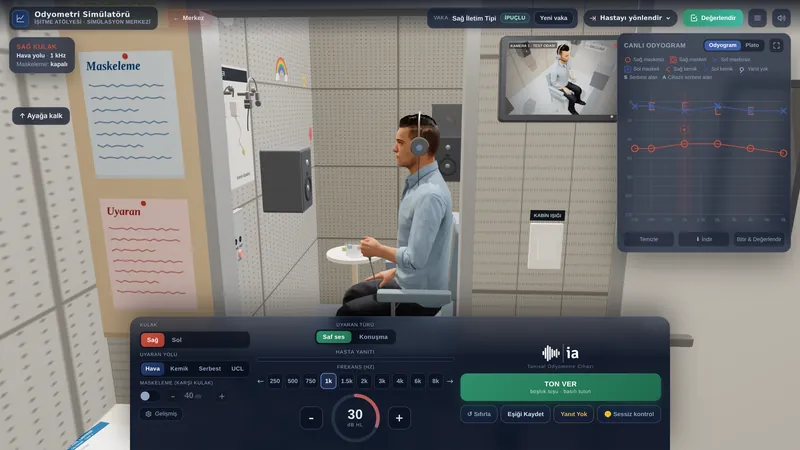
- Pure-tone audiometry: usually a bilateral, severe to profound sensorineural loss sloping towards the high frequencies. A low-frequency air-bone gap with a normal tympanogram may be present, reflecting the inner ear “third window” effect of the enlarged aqueduct (Smith et al., 2025).
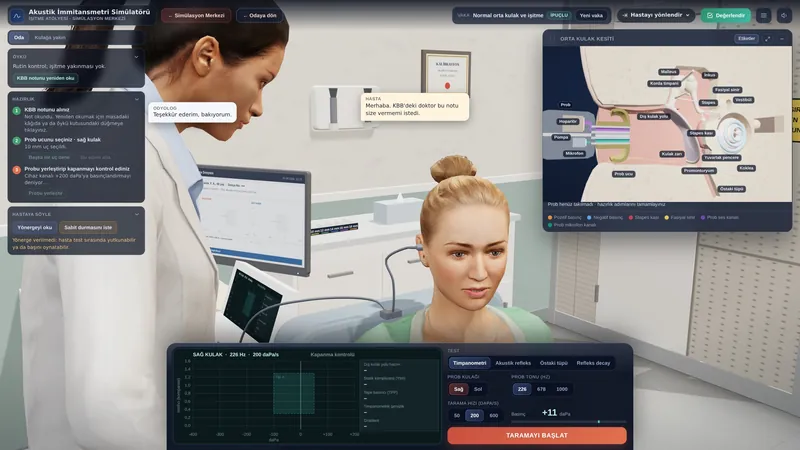
- Tympanometry and acoustic reflexes: the tympanogram is normal and there is no middle ear disease despite the air-bone gap, so a loss that looks mixed should not be mistaken for otosclerosis or effusion.
- Serial audiograms: essential for documenting fluctuation and stepwise drops; after a new drop, speech tests and comparison with earlier audiograms are needed.
- OAE and ABR: used in young children to estimate thresholds and the degree of loss.
- Vestibular tests: caloric, rotational, video head impulse test (vHIT) and VEMP; vestibular assessment is advised before cochlear implantation (Smith et al., 2025).
- Imaging: CT or MRI; a vestibular aqueduct width of 1.0 mm or more at the midpoint, or 2.0 mm or more at the operculum, is taken as EVA. Incomplete partition type II is present in 22-74% and modiolar deficiency is common; with an enlarged vestibule this is known as the Mondini triad (Smith et al., 2025). See inner ear malformations for details.
- Thyroid: thyroid function tests are usually normal and ultrasound is used for diagnosis. The perchlorate discharge test is the most sensitive test for the organification defect but is now rarely used (Smith et al., 2025). Radioiodine is given, followed by perchlorate, and a discharge of more than 10% of thyroid iodine is positive; in one series the test was positive in 52 of 57 patients (Reardon et al., 1999).
The differential diagnosis includes non-syndromic EVA without thyroid involvement, congenital cytomegalovirus infection and other genetic conditions that can produce EVA or cochlear hypoplasia (Smith et al., 2025). For an overview of genetic hearing loss, see non-syndromic hearing loss.
Treatment and audiological rehabilitation
Hearing aids are used for mild to severe loss, and a cochlear implant (CI) should be considered in children who gain limited benefit from them. Children with SLC26A4-related loss receive implants later than children with other non-syndromic loss (a mean of 60 months compared with 12 months or younger). Perilymph gusher can occur during surgery and transient vertigo is common afterwards (Smith et al., 2025). A systematic review of CI in patients with EVA found improved auditory and speech outcomes in all studies, while noting that perilymph or cerebrospinal fluid leaks and partial electrode insertion can complicate surgery (Alahmadi et al., 2022).
For monitoring, audiometry every 3-6 months until the age of three and yearly thereafter is recommended, with CI candidacy reviewed at each visit (Smith et al., 2025). After a sudden drop, audiological testing is repeated and compared with earlier audiograms; any drug treatment is decided by the physician. For the thyroid, a baseline ultrasound after age 10 and further checks every 5-10 years depending on examination are suggested; thyroid function tests are done when symptoms or signs arise, and thyroid treatment is planned by an endocrinologist (Smith et al., 2025).
There is no evidence that avoiding contact sports or head trauma prevents progression of hearing loss, and families are encouraged to make their own decisions (Smith et al., 2025). In a meta-analysis of patients with EVA, sudden drops after minor head injury were reported in about a third of patients; Pendred syndrome was not a risk factor, and only pre-existing fluctuating hearing loss was a significant predictor (Noordman et al., 2015).
Impact on quality of life and advice
Because the hearing loss in Pendred syndrome fluctuates and progresses in steps, the child and family often have to adapt to changing hearing. Hearing aid settings need updating after each drop, and as the loss progresses, early and continuous auditory rehabilitation becomes important for language development, school achievement and social communication. Episodes of dizziness and clumsiness can affect play, sport and school activities.
Practical advice:
- If you notice a sudden change in how your child hears with their hearing aids, keep a note and contact the audiologist without waiting.
- Decide about contact sports and helmets with your doctor and audiologist, bearing in mind that the evidence is limited; more caution may be reasonable in children with previous fluctuations.
- At school, a remote microphone system and an informed teacher reduce listening effort.
- Keep up with thyroid checks and follow your doctor’s advice on iodised salt and diet.
- Seek genetic counselling; hearing screening and, where appropriate, genetic testing can be arranged for siblings.
If you used this review, you can cite it as follows (APA 7):
Auditory Scene. (2026). Pendred Syndrome. Hearing & Balance Health Guide. https://auditoryscene.com/guncel-haberler/categories/isitme-sagligi-rehberi/pendred-sendromu/Permanent link: auditoryscene.com/guncel-haberler/categories/isitme-sagligi-rehberi/pendred-sendromu/ · Last reviewed: October 2026 · License: CC BY-NC-ND 4.0
References
- Alahmadi, A., Abdelsamad, Y., Salamah, M., et al. (2022). Cochlear implantation in adults and pediatrics with enlarged vestibular aqueduct: A systematic review on the surgical findings and patients’ performance. European Archives of Oto-Rhino-Laryngology, 279(12), 5497-5509.
- Everett, L. A., Glaser, B., Beck, J. C., et al. (1997). Pendred syndrome is caused by mutations in a putative sulphate transporter gene (PDS). Nature Genetics, 17(4), 411-422.
- Fitoz, S., Sennaroglu, L., Incesulu, A., et al. (2007). SLC26A4 mutations are associated with a specific inner ear malformation. International Journal of Pediatric Otorhinolaryngology, 71(3), 479-486.
- Noordman, B. J., van Beeck Calkoen, E., Witte, B., et al. (2015). Prognostic factors for sudden drops in hearing level after minor head injury in patients with an enlarged vestibular aqueduct: A meta-analysis. Otology & Neurotology, 36(1), 4-11.
- Reardon, W., Coffey, R., Chowdhury, T., et al. (1999). Prevalence, age of onset, and natural history of thyroid disease in Pendred syndrome. Journal of Medical Genetics, 36(8), 595-598.
- Smith, R. J. H., Azaiez, H., & Odell, A. M. (2025). SLC26A4-related sensorineural hearing loss. In M. P. Adam, S. Bick, G. M. Mirzaa, et al. (Eds.), GeneReviews®. University of Washington, Seattle. (Original work published 1998; last updated 3 April 2025.)
- Wémeau, J.-L., & Kopp, P. (2017). Pendred syndrome. Best Practice & Research Clinical Endocrinology & Metabolism, 31(2), 213-224.
Frequently asked questions
Are Pendred syndrome and enlarged vestibular aqueduct the same thing?
No. An enlarged vestibular aqueduct is an imaging finding and is the inner ear feature of Pendred syndrome. In Pendred syndrome thyroid involvement is also present; in patients without thyroid features the condition is called non-syndromic enlarged vestibular aqueduct.
My child passed newborn hearing screening; could they still have Pendred syndrome?
Yes. Many children with Pendred syndrome pass newborn screening, and the hearing loss appears or progresses later. Children at risk therefore need regular audiological monitoring.
When does goitre appear?
Goitre usually develops slowly after the age of 10, and not everyone gets it. Thyroid function tests are often normal, so the thyroid is followed with regular examination and ultrasound.
Can a knock to the head affect hearing?
Sudden drops in hearing after minor head injury have been reported, but the risk is not the same for everyone and avoidance has not been shown to prevent progression. More care may be reasonable in children whose hearing already fluctuates; decide together with your doctor.
Will a cochlear implant work?
Hearing and speech outcomes after cochlear implantation are generally good in patients with an enlarged vestibular aqueduct. Fluid can leak from the inner ear during surgery and short-lived dizziness can follow; the surgical team prepares for these risks in advance.
Could siblings have the same condition?
Because inheritance is autosomal recessive, when both parents are carriers the chance of an affected child is 25% in each pregnancy. Genetic counselling and hearing assessment of siblings are recommended.
Questionnaires that can be used to follow the child’s auditory development and balance symptoms: