 Auditory Scene
At a glance
Neural synchrony is disrupted by a transmission problem at the inner hair cells, ribbon synapses or auditory nerve, while the outer hair cells are preserved.
Speech understanding is poorer than the pure-tone thresholds would suggest, and following speech in noise is particularly difficult.
It is not an emergency, but in infants early diagnosis is decisive for language development.
Management is individual: remote microphone systems, hearing aids in selected cases and a cochlear implant in suitable cases.
Medical disclaimer. This content is for informational purposes only and does not replace a physician’s examination, diagnosis or treatment; it should not be used as medical advice. For your complaints or personal situation, always consult an ear, nose and throat physician and an audiologist.
If your baby’s hearing screen flagged a problem (especially after neonatal intensive care) or your child seems to “hear but not understand” or to “hear sometimes but not at other times”, see an audiologist. Screening with OAE alone can miss ANSD; an ABR assessment is needed.
Definition and epidemiology
Auditory neuropathy spectrum disorder (ANSD) is a condition in which neural synchrony is disrupted by a transmission problem at the inner hair cells, ribbon synapses or auditory nerve, while outer hair-cell function is preserved. The term “auditory neuropathy” was first proposed in 1996 (Starr et al., 1996).
When the problem lies at the synapse, the term “auditory synaptopathy” is used, and when it lies in the nerve, “auditory neuropathy”. In both, the core problem is not detecting sound but transmitting it with intact timing (Moser and Starr, 2016).
ANSD is more common in infants who have needed neonatal intensive care and accounts for a small but important share of congenital hearing loss. OAE screening alone is therefore not sufficient (Rance and Starr, 2015).
Symptoms and signs
The most typical feature is a mismatch between pure-tone thresholds and speech understanding: the person can hear sounds but has marked difficulty following speech, especially in noise.
Thresholds can range from normal to profound and fluctuate in some cases. In some genetic forms hearing worsens temporarily during a febrile illness and recovers when the fever settles.
In children, delayed speech and language development and the impression that the child ‘sometimes hears and sometimes doesn’t’ are common, and this can delay diagnosis.
Causes and risk factors
The cause can be genetic, perinatal or idiopathic. The OTOF gene (otoferlin) disrupts synaptic release and produces a presynaptic form, while the OPA1 gene produces a postsynaptic form at the level of the auditory nerve. PJVK (pejvakin) variants are associated with an excessive vulnerability to noise damage (Moser and Starr, 2016).
Non-genetic risk factors include high neonatal bilirubin (jaundice), prematurity and hypoxia, which can impair the maturation or function of the auditory pathways (Rance and Starr, 2015).
Establishing the genotype-phenotype relationship helps, in particular, to predict cochlear implant outcomes.
Audiological and clinical assessment
The “cross-check” principle is essential in diagnosing ANSD; a normal result on a single test does not exclude it. Screening with OAE alone, in particular, can miss ANSD.
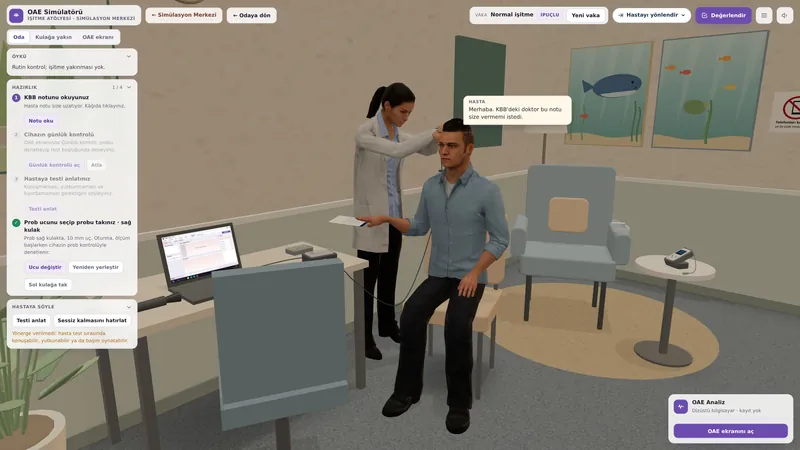
- OAE: usually present and normal (outer hair cells preserved).
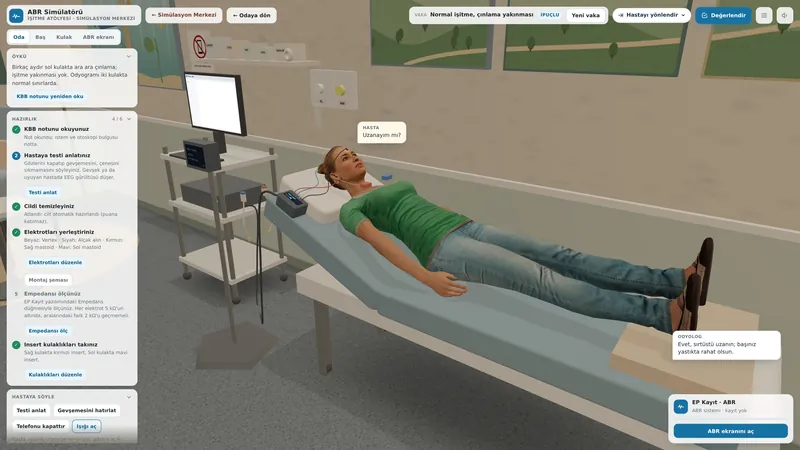
- Cochlear microphonic (CM): present and normal, reflecting receptor function. On the ABR recording it appears as an early wave that inverts when stimulus polarity is reversed; a control run with the sound tube clamped separates it from stimulus artefact.
- ABR: absent or markedly abnormal, showing neural dyssynchrony; this is the key to the diagnosis.
- Acoustic reflexes: usually absent or with very high thresholds.
- Cortical auditory evoked potentials: in children without a recordable ABR, they show whether sound reaches the cortex and help with amplification decisions (Rance and Starr, 2015).
- ECochG and electrical tests (eABR, eCAP): used to localise the lesion and in assessment before cochlear implantation.
- MRI: needed because an absent or hypoplastic auditory nerve can produce the same test pattern.
For this reason, newborn hearing screening in at-risk infants should use ABR.
| Test | What it measures | Typical ANSD finding |
|---|---|---|
| OAE | Outer hair-cell function | Present / normal |
| Cochlear microphonic (CM) | Receptor (hair-cell) response | Present / normal |
| ABR | Neural synchrony | Absent / markedly abnormal |
| Acoustic reflex | Brainstem reflex pathway | Absent / very high threshold |
| Speech discrimination | Functional hearing | Worse than expected for thresholds |
Treatment and audiological rehabilitation
Management is individual; decisions rest on the child’s speech and language development and functional hearing rather than on pure-tone thresholds.
Remote microphone systems improve the signal-to-noise ratio and support communication, particularly in school-age children. Some patients benefit from hearing aids.
A cochlear implant is an effective option, especially when speech discrimination is poor. Outcomes depend on the site of the lesion: they are usually very good in synaptic forms (e.g. OTOF) but variable when the auditory nerve is involved (Moser and Starr, 2016; Rance and Starr, 2015). Gene therapy is a promising area of research in OTOF-related forms: in a single-arm early-phase trial, hearing improved in five of the six treated children. These treatments are still at the research and early-use stage and are specific to particular gene variants (Lv et al., 2024).
Impact on quality of life and advice
Unpredictable hearing can cause anxiety in the child and family and uneven progress at school. Early and accurate diagnosis is decisive for starting the right rehabilitation in time.
Remote microphone systems in noisy settings, improved classroom acoustics and regular follow-up are recommended. Family counselling, realistic expectations and communication support are important parts of the process.
If you used this review, you can cite it as follows (APA 7):
Auditory Scene. (2026). Auditory Neuropathy Spectrum Disorder (ANSD). Hearing & Balance Health Guide. https://auditoryscene.com/guncel-haberler/categories/isitme-sagligi-rehberi/isitsel-noropati-spektrum-bozuklugu/Permanent link: auditoryscene.com/guncel-haberler/categories/isitme-sagligi-rehberi/isitsel-noropati-spektrum-bozuklugu/ · Last reviewed: October 2026 · License: CC BY-NC-ND 4.0
References
- Lv, J., Wang, H., Cheng, X., et al. (2024). AAV1-hOTOF gene therapy for autosomal recessive deafness 9: A single-arm trial. The Lancet, 403(10441), 2317-2325.
- Moser, T., & Starr, A. (2016). Auditory neuropathy: Neural and synaptic mechanisms. Nature Reviews Neurology, 12(3), 135-149.
- Rance, G., & Starr, A. (2015). Pathophysiological mechanisms and functional hearing consequences of auditory neuropathy. Brain, 138(11), 3141-3158.
- Starr, A., Picton, T. W., Sininger, Y., et al. (1996). Auditory neuropathy. Brain, 119(3), 741-753.
Frequently asked questions
My child hears sounds but doesn’t understand; how can that be?
In auditory neuropathy the inner ear can detect sounds, but they are not carried along the auditory nerve to the brain with regular timing. The child notices that a sound is there but struggles to make sense of speech, especially in noise. The condition can be recognised and supported with the right approaches.
Does a ‘pass’ on an OAE test mean my child hears normally?
Not always. OAEs test only part of the inner ear, and in auditory neuropathy they can be normal. An ABR should therefore also be done, particularly in babies who have been in intensive care, so that the diagnosis is not missed.
Why do febrile illnesses affect hearing?
In some genetic forms, proteins involved in hearing are sensitive to heat, so hearing can drop markedly for a while when body temperature rises. Recovery of hearing once the fever settles is a distinctive feature of these forms.
Does a cochlear implant work in every child with ANSD?
A cochlear implant gives very good results in many children, especially when the problem is at the synapse. When the auditory nerve is severely affected, however, outcomes vary. A detailed electrophysiological and imaging assessment is therefore carried out before deciding on an implant.
Is gene therapy available now?
Early-phase trials of gene therapy in OTOF-related forms have produced promising results. However, these treatments are still at the research and early-use stage, apply only to particular gene variants and are not suitable for every patient.
Scales that can be used to monitor language development and everyday listening in children: