 Auditory Scene
At a glance
A sensorineural loss caused by prolonged exposure to noise above 85 dBA (NIHL) or by a single intense sound such as an explosion (acoustic trauma).
Difficulty following speech in noise and tinnitus stand out; acoustic trauma causes sudden tinnitus, fullness, pain and reduced hearing.
After acoustic trauma, assessment within hours or days is needed; corticosteroids may be considered at the doctor’s discretion.
Prevention comes first; hearing aids are used for permanent loss, and sound therapy and counselling for tinnitus.
Medical disclaimer. This content is for informational purposes only and does not replace a physician’s examination, diagnosis or treatment; it should not be used as medical advice. For your complaints or personal situation, always consult an ear, nose and throat physician and an audiologist.
If you develop tinnitus, ear fullness, pain or a sudden drop in hearing after an explosion, gunshot or very loud environment, see an ear, nose and throat doctor within the first hours or days; early treatment of acoustic trauma can preserve hearing. If you work in constant noise, have regular hearing checks.
Definition and epidemiology
Noise-induced hearing loss (NIHL) is an insidious, usually bilateral and symmetrical sensorineural loss that develops after years of repeated exposure to high noise levels. Acoustic trauma, by contrast, is acute damage caused by a single, very intense impulse sound such as an explosion or gunshot.
It is one of the leading causes of preventable hearing loss. Workplace noise, military exposure and loud music or entertainment venues are the main sources (Basner et al., 2014).
The damage mainly affects the outer hair cells of the organ of Corti; very intense sounds cause mechanical destruction, whereas long-term exposure causes metabolic injury involving free radicals (Le et al., 2017).
Symptoms and signs
In NIHL, hearing loss progresses slowly and unnoticed, affecting the high frequencies first. Early symptoms are difficulty following speech in noisy places and tinnitus.
In acoustic trauma the symptoms are sudden: tinnitus, ear fullness, pain and reduced hearing may follow the intense sound. Some symptoms are temporary, others permanent.
A temporary threshold shift (TTS) after exposure may recover within hours or days, but with repeated exposure a permanent threshold shift (PTS) can develop.
Causes and risk factors
The key factors are the level and duration of the noise. NIOSH recommends a limit of 85 dBA averaged over 8 hours, with the permitted time halving for every 3 dB increase; at this level the excess risk of NIHL over a 40-year working life is 8%. The generally accepted limit for impulse noise, never to be exceeded, is a peak sound pressure level of 140 dB (NIOSH, 1998).
Not wearing hearing protection, concurrent use of ototoxic drugs, smoking and genetic susceptibility increase the risk.
Studies in mice have shown that noise exposure after which thresholds fully recover can still permanently destroy synapses between inner hair cells and the auditory nerve (Kujawa and Liberman, 2009). The relevance of this cochlear synaptopathy in humans is still being investigated.
Audiological and clinical assessment
Assessment starts with the history (source and duration of exposure, use of protection) and examination. The aim is to document the link between the loss and noise and to exclude other causes.
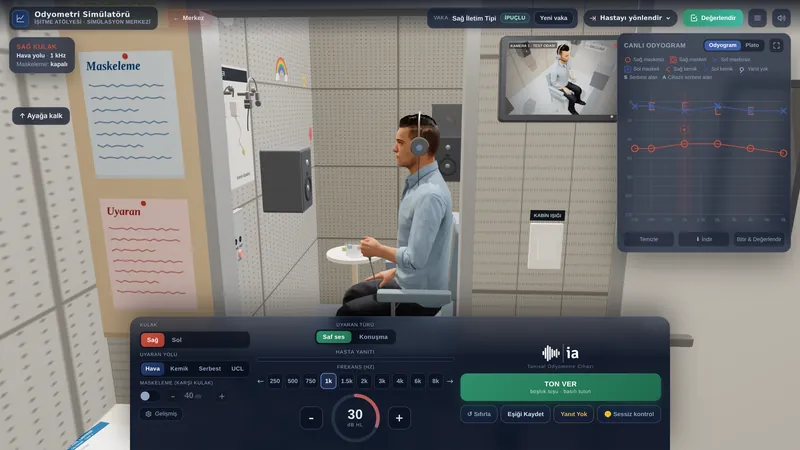
- Pure-tone audiometry: a noise notch in the 3000-6000 Hz band, with partial recovery at 8000 Hz, is typical (Le et al., 2017).
- Extended high-frequency audiometry: may reveal early damage before the standard frequencies are affected.
- OAEs: objectively show early deterioration of outer hair cell function.
- Speech and speech-in-noise tests: show the functional impact of the loss.
- ABR: used when needed for retrocochlear differential diagnosis and threshold confirmation.
Regular audiometric monitoring in workplace hearing conservation programmes allows damage to be detected before it progresses. Marked asymmetry or sudden worsening suggests another cause.
Treatment and audiological rehabilitation
Established NIHL is permanent, so the emphasis is on prevention. In acute acoustic trauma, early corticosteroid treatment may be considered; the evidence is limited and the decision rests with the doctor.
For permanent loss, a hearing aid is the first step in rehabilitation; programmes for speech in noise and remote microphone systems help. A cochlear implant is considered in the rare cases of profound loss.
If tinnitus is present, sound therapy and counselling are offered. Hearing-protection education is key to preventing further progression.
Impact on quality of life and advice
Hearing loss and tinnitus can affect communication, safety at work, sleep and mood. The most important message is that NIHL is largely preventable.
Wear hearing protection in loud places, limit sound levels and exposure time, and have regular hearing checks. A commonly recommended rule of thumb for headphones is to keep the volume at no more than 60% and take a break every 60 minutes.
If you used this review, you can cite it as follows (APA 7):
Auditory Scene. (2026). Noise-Induced Hearing Loss and Acoustic Trauma. Hearing & Balance Health Guide. https://auditoryscene.com/guncel-haberler/categories/isitme-sagligi-rehberi/gurultuye-bagli-isitme-kaybi/Permanent link: auditoryscene.com/guncel-haberler/categories/isitme-sagligi-rehberi/gurultuye-bagli-isitme-kaybi/ · Last reviewed: October 2026 · License: CC BY-NC-ND 4.0
References
- Basner, M., Babisch, W., Davis, A., et al. (2014). Auditory and non-auditory effects of noise on health. The Lancet, 383(9925), 1325-1332.
- Kujawa, S. G., & Liberman, M. C. (2009). Adding insult to injury: Cochlear nerve degeneration after ‘temporary’ noise-induced hearing loss. Journal of Neuroscience, 29(45), 14077-14085.
- Le, T. N., Straatman, L. V., Lea, J., et al. (2017). Current insights in noise-induced hearing loss: A literature review of the underlying mechanism, pathophysiology, asymmetry, and management options. Journal of Otolaryngology-Head & Neck Surgery, 46(1), 41.
- National Institute for Occupational Safety and Health. (1998). Criteria for a recommended standard: Occupational noise exposure, revised criteria 1998 (DHHS [NIOSH] Publication No. 98-126). NIOSH.
Frequently asked questions
Can a single loud sound cause permanent damage?
Yes. A single very intense sound such as an explosion or gunshot can exceed the inner ear’s tolerance limit and cause instant, permanent damage (acoustic trauma). This is why hearing protection must be used in such environments.
I had tinnitus after a concert; will it pass?
Tinnitus and a blocked feeling after a loud event are usually a temporary threshold shift and often settle within a few days. They are a warning, however: repeated exposure can lead to permanent hearing loss. Seek advice if the tinnitus or reduced hearing persists.
How can I tell whether my hearing loss is from noise or age?
Noise-induced loss usually forms a typical notch around 4000 Hz on the audiogram and is evaluated together with the exposure history. Although a definite distinction is not always easy, the history and test findings guide your physician.
Does using hearing protectors stop me hearing speech?
Well-chosen protectors do not block sound completely; they reduce harmful loud sounds while still letting you hear most speech. Electronic (active) protectors pass on surrounding speech while limiting sudden intense sounds.
What is hidden hearing loss?
Animal studies show that intense noise can damage the connections (synapses) of the hearing nerve even when the standard hearing test returns to normal. In humans, this hidden damage is thought to contribute to difficulty following speech in noise, and it is still being researched.
Scales that can be used to monitor noise sensitivity, attitude and hearing handicap: