 Auditory Scene
At a glance
Functional hearing loss is a measured hearing loss that cannot be explained by an organic cause, or that is clearly greater than any organic findings.
The reported loss is often bilateral, flat and moderate; the mismatch between everyday communication and the test results is striking.
It is not an emergency in itself, but it should only be diagnosed once organic causes needing urgent treatment, such as sudden hearing loss, have been excluded.
Diagnosis relies on the cross-check principle and objective tests; management means non-judgemental counselling and psychosocial support where needed.
Medical disclaimer. This content is for informational purposes only and does not replace a physician’s examination, diagnosis or treatment; it should not be used as medical advice. For your complaints or personal situation, always consult an ear, nose and throat physician and an audiologist.
If your hearing loss came on suddenly, or is accompanied by tinnitus, dizziness or facial weakness, see an ear, nose and throat doctor without delay; functional loss is only considered once organic causes have been ruled out. If you have been told that your child’s hearing tests are inconsistent, go through the results in detail with your audiologist and ask for objective testing to be completed.
Definition and epidemiology
Functional hearing loss describes behavioural thresholds that do not reflect a person’s true hearing: the reported loss cannot be explained by an organic cause, or it is clearly worse than any organic finding. The terms non-organic hearing loss, pseudohypacusis and exaggerated hearing loss are also used. Austen and Lynch (2004) proposed viewing these behaviours as a continuum defined by the degree of conscious intent, from conversion, in which the symptom is not consciously produced, to deliberate exaggeration for financial or legal gain. Tests cannot reveal intent, so the audiologist does not pass judgement on it but documents the mismatch between measured thresholds and true hearing.
The condition is not confined to people with entirely normal hearing. A functional overlay on an organic loss is common: in a series of 40 patients from Bern, 27% of the children had a history of middle ear problems with transient hearing loss, and a small air-bone gap of 5-20 dB was a typical finding (Holenweg and Kompis, 2010). Frequency varies widely with age and reason for referral. Among 48 children assessed for sudden hearing loss, 54% were diagnosed with pseudohypacusis, making it the most frequent cause of sudden hearing loss in that population (Psarommatis et al., 2009). In adults it is usually encountered alongside military medical examinations, workplace accidents or compensation claims (Austen and Lynch, 2004; Durmaz et al., 2009).
Symptoms and signs
In children the problem is usually picked up at a school screening or when a teacher notices that the child ‘does not hear’. In the Bern series the children were aged 7-16 years (mean 10.6), girls were more often affected, and half of the children knew someone with hearing loss (Holenweg and Kompis, 2010). The mean age in the series of Psarommatis et al. (2009) was likewise 10.5 years, with a majority of girls. In adults the complaint often follows an accident, an alleged noise exposure or the need for a medical board report.
Some clues may emerge during the interview and examination: the person may follow conversation more easily than the reported loss would allow, respond to speech when facing away, or, conversely, lip-read in an exaggerated way. These observations are not diagnostic, but they should prompt a careful test battery. Otoscopy is usually normal, and any minor findings do not account for the degree of loss. The reported loss is often bilateral and flat or saucer-shaped; most audiograms in the Bern series showed a frequency-independent, apparently sensorineural loss of 40-60 dB (Holenweg and Kompis, 2010).
When a functional loss goes unrecognised it can lead to unnecessary investigations, medication and amplification. In the same series, 22.5% of patients had already been fitted with hearing aids before their first visit to the centre (Holenweg and Kompis, 2010). An inconsistent audiogram therefore calls for cross-checking before any decision on hearing aids or surgery.
Causes and risk factors
In functional hearing loss there is no structural damage that accounts for the loss; the inconsistency lies in the behavioural responses themselves. Austen and Lynch (2004) arrange the underlying processes by degree of conscious intent. In conversion the symptom is not consciously produced: psychological distress is expressed as a hearing complaint. In factitious disorder the symptom is produced deliberately, but the aim is the sick role rather than external gain. In malingering the person consciously exaggerates the loss for financial, legal or military gain. In practice these categories rarely have sharp boundaries.
Risk factors differ with age. In children, difficulties at school or at home and having someone with hearing loss nearby stand out; in the Bern series 27% of the children had previous middle ear problems and 50% knew someone with hearing loss (Holenweg and Kompis, 2010). This suggests that a child who has experienced, or closely observed, a real hearing loss may model that experience. In adults, compensation, disability and military fitness assessments are the main drivers; all 200 cases in the study by Durmaz et al. (2009) came from military candidate examinations.
Audiological and clinical assessment
Diagnosis rests on the cross-check principle: no test result is accepted until it is confirmed by an independent measure. Described by Jerger and Hayes in 1976 for paediatric audiology, the principle is now applied with a test battery that includes OAEs, ASSR and ABR (Hall, 2016). When functional loss is suspected, the aim is to demonstrate the mismatch between behavioural thresholds and objective findings and, where possible, to establish true thresholds.
- Speech reception threshold (SRT) versus pure-tone average (PTA): in organic loss the SRT agrees closely with the PTA (American Speech-Language-Hearing Association [ASHA], 1988). An SRT that is clearly better than the PTA is the classic sign; the person repeats words at levels where they claim not to hear tones. The Bern series also showed that speech audiometry can be considerably poorer than the pure-tone thresholds predict, so a mismatch in either direction is notable (Holenweg and Kompis, 2010).
- Poor test-retest reliability: thresholds that shift within a session or over a short interval, and ascending and descending thresholds that disagree, are important. Objective testing itself can change behaviour: when OAEs and tympanometry were added to the protocol, thresholds on repeat audiometry improved by a mean of 35.2 dB, against 11.0 dB in the group without them (Balatsouras et al., 2003).
- Acoustic reflex thresholds: in organic loss the stapedial reflex appears well above the behavioural threshold. A reflex elicited close to, or even below, the reported threshold shows that the person actually hears that level. This is a strong clue but does not on its own give the true threshold.
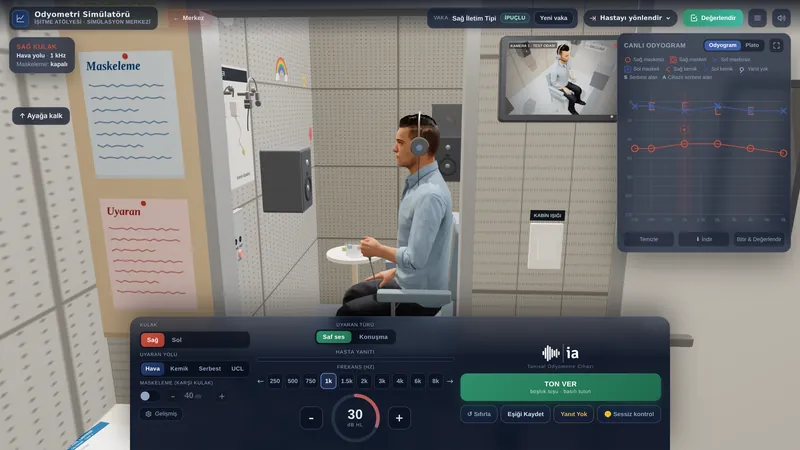
- Absent shadow curve: in unilateral loss, sound presented unmasked to the poorer ear crosses to the other ear once it exceeds interaural attenuation and is heard by the better ear. An organic unilateral loss therefore produces a shadow curve that follows the better ear on the unmasked audiogram. No response at all from the poorer ear, even at high output levels, means the person is also failing to respond to sound heard by the better ear.
- Stenger test: used in unilateral or markedly asymmetric loss. When the same frequency is presented to both ears simultaneously, it is perceived only in the ear where it is louder (the Stenger principle). If a tone just above threshold is given to the good ear and a tone below the reported but above the true threshold to the ‘poor’ ear, a person with functional loss hears it only in the poor ear and does not respond; this is a positive Stenger. Against ABR as the reference, sensitivity was 99.4% and specificity 70% in 200 military candidates (Durmaz et al., 2009).
- OAEs: emissions that are stronger than the reported loss would allow show preserved outer hair cell function. OAEs are quick and cheap but reflect only the cochlea; they do not exclude a neural problem and do not give a threshold.
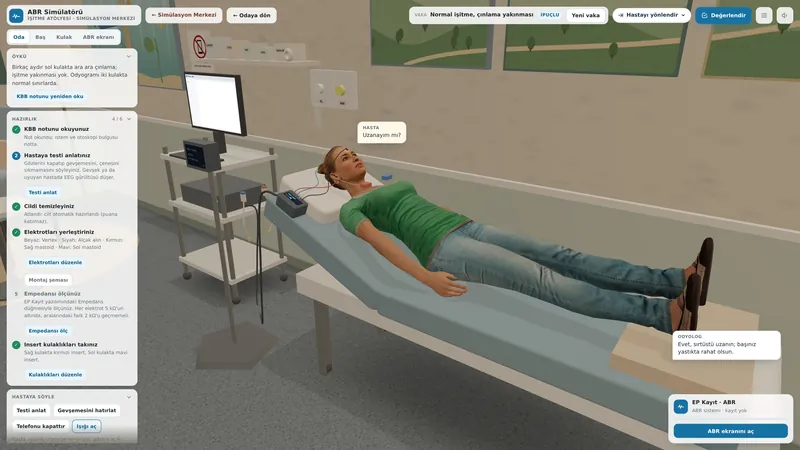
- Threshold estimation with ABR and ASSR: frequency-specific thresholds (tone-burst ABR or ASSR) are the main way to estimate true hearing when reliable behavioural responses cannot be obtained. In the Bern series, OAEs and/or evoked potentials were normal or substantially better than pure-tone thresholds in every case (Holenweg and Kompis, 2010). ASSR and pure-tone thresholds differed significantly in patients with functional loss but agreed in those with sensorineural loss (Kariya et al., 2008).
| Test | Organic loss | Functional loss |
|---|---|---|
| SRT and PTA | Close agreement | Clear mismatch |
| Repeat testing | Consistent thresholds | Thresholds shift, often improve |
| Acoustic reflex | Well above threshold | Near or below reported threshold |
| Unmasked unilateral loss | Shadow curve | No shadow curve |
| Stenger test | Negative | Positive |
| OAE, ABR, ASSR | Consistent with loss | Normal or much better |
The first step in differential diagnosis is to exclude organic causes, particularly sudden hearing loss, ANSD and retrocochlear disease. In ANSD, OAEs are present but the ABR is absent or grossly abnormal, whereas in functional loss ABR thresholds are normal or near normal. In auditory processing disorder, pure-tone thresholds are normal and the difficulty lies in higher-level skills such as listening in noise. When a functional overlay on organic loss is suspected, the aim is to grade and manage the organic component correctly.
Treatment and audiological rehabilitation
Management starts with an accurate diagnosis. Once a functional component is found, the aim is not to ‘catch out’ the person but to establish true hearing, avoid unnecessary medication and amplification, and recognise the underlying need. Results are shared in a non-accusatory way: the audiologist explains that the tests disagree and that objective measures show the auditory system working well, and avoids phrases such as ‘you are pretending’. Thresholds often improve when testing is repeated after a short break and fresh instructions; this lets the person’s results improve without having to defend themselves.
With children, a separate conversation with the parents is advisable, and embarrassing remarks in front of the child should be avoided. Parents are told that the child’s hearing is preserved but that the complaint may reflect a need, and difficulties at school, at home and with friends are explored. If a psychosocial problem is suspected, referral to child and adolescent mental health services, or to psychiatry or psychology for adults, is planned with the doctor. Treatments used for sudden hearing loss, such as corticosteroids, have no place in functional loss; decisions on medication rest with the doctor, and an accurate diagnosis prevents unnecessary drug use.
Where a functional overlay sits on an organic loss, the organic component is treated or aided as needed, with hearing aid gain based on thresholds confirmed by objective tests. In medico-legal assessments the report should document the tests used and the inconsistencies objectively; if reliable behavioural thresholds cannot be obtained, thresholds estimated from ABR or ASSR are reported separately. Follow-up should allow for the possibility of recurrence and include a review audiogram.
Impact on quality of life and advice
Functional hearing loss can signal genuine distress. For a child the real problem is often not hearing at all but difficulties at school, at home or with friends; if these go unnoticed, the complaint may return in another form. A wrong diagnosis, on the other hand, can lead to unnecessary hearing aids, special educational provision or a child being labelled as having hearing loss.
In adults a functional component may be intertwined with work and legal proceedings. The audiologist’s role is to document true hearing objectively; this protects both the individual’s rights and the fair use of resources. In someone with an organic loss, recognising the functional component is also essential for rehabilitating the organic part correctly.
Ask your audiologist openly about your test results; repeating measurements on different days and carrying out objective tests is a normal part of the process. If this has been found in your child, avoid blaming them, create a setting where school and friendships can be talked about, and seek mental health support when needed.
If you used this review, you can cite it as follows (APA 7):
Auditory Scene. (2026). Functional (Non-organic) Hearing Loss. Hearing & Balance Health Guide. https://auditoryscene.com/guncel-haberler/categories/isitme-sagligi-rehberi/fonksiyonel-isitme-kaybi/Permanent link: auditoryscene.com/guncel-haberler/categories/isitme-sagligi-rehberi/fonksiyonel-isitme-kaybi/ · Last reviewed: October 2026 · License: CC BY-NC-ND 4.0
References
- American Speech-Language-Hearing Association. (1988). Determining threshold level for speech [Guidelines]. ASHA.
- Austen, S., & Lynch, C. (2004). Non-organic hearing loss redefined: Understanding, categorizing and managing non-organic behaviour. International Journal of Audiology, 43(8), 449-457.
- Balatsouras, D. G., Kaberos, A., Korres, S., et al. (2003). Detection of pseudohypacusis: A prospective, randomized study of the use of otoacoustic emissions. Ear and Hearing, 24(6), 518-527.
- Durmaz, A., Karahatay, S., Satar, B., et al. (2009). Efficiency of Stenger test in confirming profound, unilateral pseudohypacusis. The Journal of Laryngology & Otology, 123(8), 840-844.
- Hall, J. W., III. (2016). Crosscheck principle in pediatric audiology today: A 40-year perspective. Journal of Audiology & Otology, 20(2), 59-67.
- Holenweg, A., & Kompis, M. (2010). Non-organic hearing loss: New and confirmed findings. European Archives of Oto-Rhino-Laryngology, 267(8), 1213-1219.
- Kariya, S., Fukushima, K., Kawasaki, A., et al. (2008). Auditory steady-state responses to multiple simultaneous stimuli in children with functional or sensorineural hearing loss. European Archives of Oto-Rhino-Laryngology, 265(7), 769-773.
- Psarommatis, I., Kontorinis, G., Kontrogiannis, A., et al. (2009). Pseudohypacusis: The most frequent etiology of sudden hearing loss in children. European Archives of Oto-Rhino-Laryngology, 266(12), 1857-1861.
Frequently asked questions
Does functional hearing loss mean someone is faking?
Not necessarily. The condition covers a wide spectrum, from states that are not consciously produced and reflect psychological distress, to deliberate exaggeration for gain. Tests do not show a person’s intent, only that measured thresholds do not match true hearing. This is why audiologists avoid judgemental language.
How is my true hearing level established?
With objective tests that do not depend on your responses. Otoacoustic emissions show that the outer hair cells of the inner ear are working, and acoustic reflexes show that a certain sound level is being heard. ABR and ASSR allow frequency-specific thresholds to be estimated. These tests are painless, and adults do not usually need sleep or sedation.
Can there be a functional component if I also have a real hearing loss?
Yes. A functional overlay on an organic loss is common; a child with previous middle ear problems, for example, may show a measured loss greater than the real one. The aim is then to identify the organic part accurately and plan the right treatment or hearing aid fitting.
My child has been found to have functional hearing loss. What should I do?
Do not blame your child or make them feel ‘caught out’ by the tests. Talk with the audiologist and doctor about possible difficulties at school, at home or with friends. Seek child and adolescent mental health support if needed, and attend the recommended follow-up tests.
What is the Stenger test?
It is a test used when someone reports hearing loss in one ear. When the same sound is presented to both ears at once, it is heard only in the ear where it is louder. The test uses this principle to show whether the reportedly poor ear actually hears; in a study using ABR as the reference, its sensitivity was very high.
Is medication or a hearing aid needed for functional hearing loss?
Not if there is no organic loss; drugs used for sudden hearing loss do not help in this situation, and decisions on medication rest with the doctor. If there is also an organic loss, any hearing aid fitting is based on thresholds confirmed by objective tests. The core approach is counselling and, where needed, psychosocial support.