 Auditory Scene
At a glance
Hearing loss is common in Down syndrome; in childhood it is mostly conductive from otitis media with effusion, and less often sensorineural or mixed.
Narrow ear canals, wax build-up and middle ear fluid are the commonest findings; hearing loss can delay speech and language development.
It is not urgent, but children who passed the newborn screen still need regular hearing assessment; in adulthood hearing loss starts early.
Watchful waiting or ventilation tubes for effusion, and hearing aids or bone conduction devices for persistent loss; regular hearing checks continue into adulthood.
Medical disclaimer. This content is for informational purposes only and does not replace a physician’s examination, diagnosis or treatment; it should not be used as medical advice. For your complaints or personal situation, always consult an ear, nose and throat physician and an audiologist.
Even if your child with Down syndrome passed the newborn hearing screen, keep up regular hearing checks. If your child responds less to sounds, their speech stalls, they often turn up the television, pull at their ears or have ear discharge, see your audiologist and an ear, nose and throat doctor. If an adult relative becomes withdrawn, forgetful or unable to follow instructions, ask for their hearing and ear canals to be checked before dementia is considered.
Definition and epidemiology
Down syndrome (trisomy 21) is one of the genetic conditions most often associated with hearing loss. The loss has three sources: narrow ear canals with wax build-up, middle ear effusion and ossicular anomalies, and sensorineural loss of inner ear origin. These components can coexist in one person and change with age. Conductive loss predominates in childhood, while in adulthood sensorineural loss begins much earlier than in the general population.
In a study of 344 babies with Down syndrome born in Utah, 26.2% did not pass newborn hearing screening; of these, 37.9% had conductive loss from effusion, five had sensorineural and three had mixed loss (Park et al., 2012). At a Belgian Down syndrome clinic, otitis media with effusion reached 66.7% at age 1 and peaked again at 60% at ages 6-7 (Maris et al., 2014). In a Dutch study of 1598 adults with intellectual disability, Down syndrome increased the risk of hearing loss about fivefold (OR 5.18), and all adults with Down syndrome over 60 had hearing loss (Meuwese-Jongejeugd et al., 2006).
Symptoms and signs
The commonest picture in childhood is a mild to moderate conductive loss from otitis media with effusion. Children with bilateral effusion had a median hearing threshold of 36.7 dB HL, compared with 28.3 dB HL in those with at least one normally ventilated middle ear (Maris et al., 2014). Effusion is often silent and is noticed only as reduced responses to sound, inattention or regression in speech, without pain or fever. Because speech and language development in Down syndrome is already slower, these signs are easily attributed to the syndrome itself.
More than 43% of babies who passed newborn screening later developed conductive loss needing ventilation tubes, and among babies who did not pass and were found to have sensorineural loss, diagnosis was delayed by an average of 485 days (Park et al., 2012). A normal newborn screen therefore does not mean hearing will stay normal. Sensorineural and mixed losses tend to progress over time, whereas conductive loss tends to improve, especially when the first tubes are placed before age 2 (Kreicher et al., 2018).
In adulthood sensorineural loss starts early. Among 72 adults with Down syndrome (mean age 37), hearing loss was found in 65.3%, rising from 42.9% at 20-29 years to 90.9% at 50-59 years, with 4 kHz most affected (Picciotti et al., 2017). The age-related rise has been estimated to begin about three decades earlier than in the general population (Meuwese-Jongejeugd et al., 2006).
Causes and risk factors
Middle ear problems stem from underdevelopment of the midface and Eustachian tube dysfunction. Chronic rhinitis, sinusitis and frequent upper respiratory infections also help effusion persist and contribute to chronic ear infections (Shott, 2006). Narrow ear canals make it harder for wax to clear naturally and increase the tendency to earwax impaction; a narrow canal also makes the eardrum and middle ear harder to examine.
The main cause of the sensorineural component is early ageing of the inner ear. The premature ageing seen in many organ systems in Down syndrome also affects hearing, producing a high-frequency pattern similar to presbycusis but starting decades earlier (Picciotti et al., 2017). Recurrent infections, chronic otitis media and cholesteatoma can also cause permanent conductive or mixed loss; conductive loss is more likely to improve in children without cholesteatoma (Kreicher et al., 2018).
Audiological and clinical assessment
Because hearing loss in children with Down syndrome is common, silent and fluctuating, assessment is carried out at regular intervals rather than waiting for symptoms. The 2022 health supervision report of the American Academy of Pediatrics (AAP) treats follow-up of the newborn hearing screen result and regular hearing assessment through childhood and adolescence as part of health supervision (Bull et al., 2022). Park et al. (2012) showed that 84% of newborns with Down syndrome who missed screening never had any later hearing test; loss to follow-up is one of the main problems in this group.
- Otoscopy: the eardrum often cannot be seen because of a narrow canal and wax. Measurements made before the canal is cleared are misleading; if needed, the child is referred to an ENT surgeon for microscopic cleaning and examination.
- Tympanometry: effusion gives a flat (type B) trace. In a narrow canal a low ear canal volume can be confused with the probe tip resting against the canal wall, so small probe tips should be used. In infants a high-frequency (1000 Hz) probe tone is preferred.
- Visual reinforcement audiometry and play audiometry: as developmental age may lag behind chronological age in Down syndrome, the method is chosen by developmental age; responses may be slower and less consistent, and testing can be split into several short sessions.
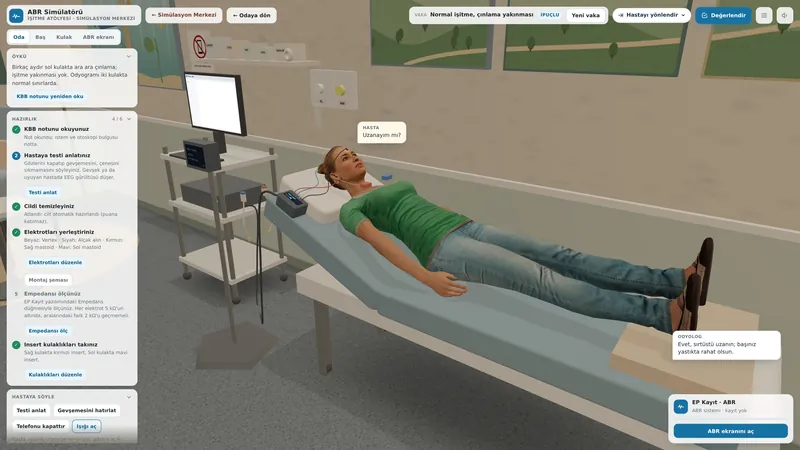
- ABR: when ear-specific behavioural thresholds cannot be obtained, air- and bone-conduction ABR establish the type and degree of loss. If sedation or anaesthesia is needed, airway problems and sleep apnoea must be considered (Shott, 2006).
- OAEs: effusion and wax can abolish OAEs, so absent OAEs alone are not evidence of sensorineural loss; in screening and monitoring they are interpreted together with tympanometry.
In adults, hearing should be monitored with pure-tone and speech testing every year or at least periodically, recording early changes at 4 kHz and above (Picciotti et al., 2017). The adult care guideline recommends starting screening for Alzheimer-type dementia at age 40 (Tsou et al., 2020). Because hearing loss can cause withdrawal, difficulty following instructions and disengagement that mimic dementia, the ear canals and hearing must be checked before cognitive assessment.
Treatment and audiological rehabilitation
Otitis media with effusion lasts longer and recurs more often in children with Down syndrome than in other children. The decision on ventilation tubes rests with the ENT surgeon; a narrow canal makes insertion and follow-up harder, and tubes may need replacing more often. Regular ear examination continues to watch for cholesteatoma and chronic otitis media. When conductive loss is likely to persist, temporary amplification can be considered rather than waiting through the critical period for language.
Persistent loss is managed with hearing aid fitting. A narrow, tortuous canal makes it harder to take impressions, seat the earmould and prevent feedback; soft mould materials, receiver options suited to small canals and frequent remakes are needed. Wax reduces the output of the aid, so checking the wax guard and regular ear cleaning are built into the plan. If recurrent discharge or a very narrow canal rules out an air-conduction aid, bone conduction devices and bone conduction implants are options. Real-ear measurement (REM) is particularly important because the acoustics of a narrow canal differ from average values.
Success depends on the aid being worn all day. Tactile sensitivity and removing the aid are common; a programme that starts with short periods and extends them with positive reinforcement should be followed together with family and teachers. At school a remote microphone system makes listening in noise easier. In adulthood, hearing aid fitting should be planned together with training carers to insert and clean the aid and change batteries.
Impact on quality of life and advice
Speech and language develop more slowly in children with Down syndrome, and even an unnoticed mild conductive loss can deepen this delay and harm attention and learning. At school, noisy classrooms combine hearing loss with difficulties in auditory attention and memory. In adulthood, early-onset hearing loss reduces social participation, can lead to loneliness and withdrawal, and may be confused with signs of dementia.
Practical advice: keep up your child’s regular hearing checks, even if they passed the newborn screen. When talking, make sure your child can see your face, use short, clear sentences and support them with signs and gestures. Do not clean the ears with cotton buds; in a narrow canal wax is pushed deeper. Start with short periods of hearing aid use and build up gradually. If you notice a change in behaviour in an adult relative, ask for a hearing test among the first investigations; correcting hearing loss can markedly improve communication and quality of life.
If you used this review, you can cite it as follows (APA 7):
Auditory Scene. (2026). Hearing in Down Syndrome. Hearing & Balance Health Guide. https://auditoryscene.com/guncel-haberler/categories/isitme-sagligi-rehberi/down-sendromunda-isitme/Permanent link: auditoryscene.com/guncel-haberler/categories/isitme-sagligi-rehberi/down-sendromunda-isitme/ · Last reviewed: October 2026 · License: CC BY-NC-ND 4.0
References
- Bull, M. J., Trotter, T., Santoro, S. L., et al. (2022). Health supervision for children and adolescents with Down syndrome. Pediatrics, 149(5), e2022057010.
- Kreicher, K. L., Weir, F. W., Nguyen, S. A., et al. (2018). Characteristics and progression of hearing loss in children with Down syndrome. The Journal of Pediatrics, 193, 27-33.e2.
- Maris, M., Wojciechowski, M., Van de Heyning, P., et al. (2014). A cross-sectional analysis of otitis media with effusion in children with Down syndrome. European Journal of Pediatrics, 173(10), 1319-1325.
- Meuwese-Jongejeugd, A., Vink, M., van Zanten, B., et al. (2006). Prevalence of hearing loss in 1598 adults with an intellectual disability: Cross-sectional population based study. International Journal of Audiology, 45(11), 660-669.
- Park, A. H., Wilson, M. A., Stevens, P. T., et al. (2012). Identification of hearing loss in pediatric patients with Down syndrome. Otolaryngology-Head and Neck Surgery, 146(1), 135-140.
- Picciotti, P. M., Carfì, A., Anzivino, R., et al. (2017). Audiologic assessment in adults with Down syndrome. American Journal on Intellectual and Developmental Disabilities, 122(4), 333-341.
- Shott, S. R. (2006). Down syndrome: Common otolaryngologic manifestations. American Journal of Medical Genetics Part C: Seminars in Medical Genetics, 142(3), 131-140.
- Tsou, A. Y., Bulova, P., Capone, G., et al. (2020). Medical care of adults with Down syndrome: A clinical guideline. JAMA, 324(15), 1543-1556.
Frequently asked questions
My child passed the newborn hearing screen. Is testing still needed?
Yes. Fluid in the middle ear is very common in the early years in children with Down syndrome, and a significant number of babies who pass screening later develop hearing loss that needs treatment. Hearing checks should therefore continue regularly throughout childhood.
Can there be fluid in the middle ear without earache?
Yes. Otitis media with effusion often causes no pain or fever. The only signs may be reduced responses to sound, inattention or a pause in speech development. Because these can be put down to Down syndrome itself, regular examination and tympanometry are important.
Why do narrow ear canals matter?
Wax builds up easily in a narrow canal and the eardrum cannot be seen. This can reduce hearing and make hearing tests misleading. It also makes it harder to fit a hearing aid mould. Do not clean the ears with cotton buds; if needed, cleaning should be done by a clinician.
Does every child need ventilation tubes?
No. The ENT surgeon decides based on how long the fluid has lasted, the degree of hearing loss and speech development. In children who cannot have tubes or whose fluid keeps returning, a hearing aid can be used temporarily.
When does hearing loss start in adults with Down syndrome?
In adults with Down syndrome, age-related hearing loss begins much earlier than in the general population, about 30 years earlier. Hearing loss is common even in the twenties and affects most people by their fifties. Regular hearing tests are therefore recommended in adulthood as well.
My relative has become forgetful. Could this be related to hearing?
It could be. Hearing loss can cause behaviour that resembles dementia, such as withdrawal, difficulty following instructions and apparent lack of interest, because speech is not understood. Ask for the ear canals and hearing to be checked before a cognitive assessment.
Scales that can be used to monitor auditory behaviour and everyday listening difficulties in children with Down syndrome: