 Auditory Scene
At a glance
The Eustachian tube stays open more than it should, so sound and pressure changes in the nasopharynx reach the middle ear directly.
Hearing one’s own voice and breathing too loudly (autophony), aural fullness and relief on lying down or bending forward are typical.
It is not an emergency, but symptoms can severely affect quality of life and other conditions with similar symptoms must be excluded.
Correcting the underlying cause and conservative measures come first; procedures that narrow or close the tube are used in refractory cases.
Medical disclaimer. This content is for informational purposes only and does not replace a physician’s examination, diagnosis or treatment; it should not be used as medical advice. For your complaints or personal situation, always consult an ear, nose and throat physician and an audiologist.
If you hear your own voice or breathing echoing inside your ear and this has lasted several weeks, goes away when you lie down or began after rapid weight loss or pregnancy, see an ear, nose and throat doctor. Be sure to mention it if you also hear your own eye movements or footsteps, or feel dizzy with loud sounds or pressure; these point to a different diagnosis. Seek prompt assessment if your hearing has dropped or you have discharge or pain.
Definition and epidemiology
The Eustachian tube is normally closed and opens briefly on swallowing and yawning to equalise middle ear pressure. In a patulous Eustachian tube (PET) it stays open at rest or opens too easily. The international consensus statement divides Eustachian tube dysfunction into a dilatory type, in which the tube does not open adequately, and a patulous type, in which it stays excessively open (Schilder et al., 2015). PET therefore sits at the opposite end from the more common obstructive Eustachian tube dysfunction; the symptoms partly overlap, but the treatments differ.
Its prevalence in the general population is estimated at 0.3-6.6% (Koltsidopoulos and Skoulakis, 2020). In a series of 56 patients with definite PET by the Japan Otological Society (JOS) criteria, ages ranged from 12 to 88 years (mean 49.3), 62.5% were women and 22 had bilateral involvement (Kawamura et al., 2019).
Symptoms and signs
The core symptom is autophony: people hear their own voice, their breathing and sometimes chewing echoing loudly inside the ear. Fullness and blockage are common, and tinnitus or mild hearing loss may be reported (Koltsidopoulos and Skoulakis, 2020). In 78 ears with definite PET by the JOS criteria, voice autophony was present in 93.6%, aural fullness in 87.2% and breathing autophony in 78.2%, with all three together in 67.9% (Kawamura et al., 2019).
The most distinctive feature is that symptoms change with posture. In the same series, symptoms improved in 91% of ears on moving from sitting to lying down or bending the head forward (Kawamura et al., 2019). Exercise and sweating can make things worse; lying down increases venous congestion so the tissues around the tube swell and close it (Chung and Naples, 2024). People may start sniffing repeatedly, bending the head or speaking more quietly to relieve the blocked feeling. On examination the drum usually looks normal, but it can be seen moving in and out while the patient breathes deeply through the nostril on the same side (Ward et al., 2023).
Causes and risk factors
Loss of tissue bulk around the tube and weakness of the structures that keep it closed are involved. Reported risk factors include rapid, marked weight loss, pregnancy, high-dose oral contraceptives or oestrogen, conditions that leave atrophy or scarring in the nasopharynx such as adenoidectomy and radiotherapy, and some neuromuscular disorders (Koltsidopoulos and Skoulakis, 2020). With weight loss, shrinkage of the fat pad beside the tube (Ostmann’s fat pad) and dehydration are thought to play a part (Chung and Naples, 2024).
Symptoms in pregnancy are usually temporary. In some patients no clear cause is found. Nasal sprays and other medicines in use should also be asked about. Patulous symptoms can also appear after procedures such as balloon dilation for obstructive Eustachian tube dysfunction, so previous ear and nasopharyngeal procedures belong in the history.
Audiological and clinical assessment
The diagnosis rests mainly on the history and examination. In their surgical series, Ward et al. (2019) based the diagnosis on autophony together with eardrum movement synchronous with breathing, and reviews recommend confirming typical symptoms by seeing the drum move with breathing or sniffing (Koltsidopoulos and Skoulakis, 2020). The JOS diagnostic criteria combine subjective symptoms, relief on changing posture or on temporarily blocking the pharyngeal opening of the tube, and objective findings, and grade the diagnosis as ‘definite’ or ‘possible’ PET (Kobayashi et al., 2018).
- Otoscopy while seated: the drum is watched while the patient closes the other nostril and breathes deeply through the same side. Drum movement was seen in 69.1% of ears with definite PET (Kawamura et al., 2019). The sign may disappear if the patient lies down or is examined long after exercise.
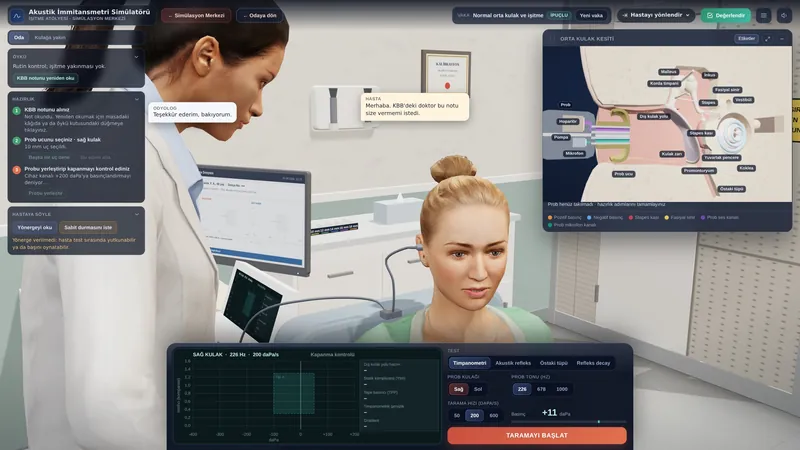
- Tympanometry and admittance recording: the static tympanogram is usually normal (type A). On a prolonged admittance recording with the probe held at a fixed pressure (for example in reflex recording mode), fluctuations in time with nasal breathing are seen and stop when the breath is held. Testing should be done seated.
- Tubo-tympano-aerography (TTAG) and sonotubometry: the objective tests in the JOS criteria. In the series, TTAG was positive in 76.9% of ears and sonotubometry in 55.1%; combining drum movement with TTAG confirmed the diagnosis in 98.5% (Kawamura et al., 2019).
- Pure-tone and speech audiometry: hearing is usually normal; testing serves to exclude findings that point elsewhere, such as a conductive loss or bone-conduction thresholds better than normal.
- Nasopharyngoscopy and imaging: the pharyngeal opening of the tube is examined. CT taken in the sitting position showed a fully open tube in 68.6% of ears, but the method has not yet been included in the diagnostic criteria (Kawamura et al., 2019). If canal dehiscence is suspected, temporal bone CT is requested.
Autophony is not specific to PET; middle ear effusion and third window syndromes can cause similar complaints (Ward et al., 2023). The most important differential diagnosis is superior semicircular canal dehiscence (SSCD). In SSCD people hear their own voice, eye movements and footsteps, but breathing autophony and postural relief are not expected; bone-conduction thresholds may be better than normal and a low-frequency air-bone gap is seen with preserved acoustic reflexes. In obstructive Eustachian tube dysfunction symptoms do not improve on lying down, and the tympanogram often shows negative pressure.
| Feature | Patulous Eustachian tube | SSCD | Obstructive Eustachian tube dysfunction |
|---|---|---|---|
| Hearing own breathing | Common | Not expected | Not expected |
| Lying down | Relieves | No change | No change |
| Eardrum | Moves with breathing | Normal | Retracted, reduced mobility |
| Tympanogram | Normal; breathing fluctuations on recording | Normal | Negative pressure (type C) |
| Audiogram | Usually normal | Bone conduction better than normal, low-frequency gap | Mild conductive loss possible |
| Other clue | Weight loss, pregnancy | Vertigo with sound or pressure | Cannot equalise when flying |
Treatment and audiological rehabilitation
Treatment is decided by the doctor according to how severe and long-lasting the symptoms are. Correcting an underlying cause (for example, stopping rapid weight loss, or the end of pregnancy) comes first, and in many patients symptoms ease on their own. Reassurance that the condition is harmless, practical measures such as lying down or bending forward when symptoms start, and adequate fluid intake are advised. Conservative options include saline nose drops, paper patching of the eardrum and measures that temporarily narrow the opening of the tube. Saline drops improved symptoms in 63.5% of 52 patients, and paper patching succeeded in 76.2% in the short term but only 38.1% in the long term (Koltsidopoulos and Skoulakis, 2020).
When conservative measures fail, procedures that narrow or close the tube are used: a silicone plug inserted into the tube through the eardrum, injection of bulking agents at the tubal opening, reconstruction of the tube wall (PETR) and complete obliteration of the tube. A review of 28 studies found improvement rates of 50-100%, mostly 71-83% in silicone plug series, but none of the studies was above a low level of evidence, and the commonest complication was otitis media with effusion, usually in under 20% (Koltsidopoulos and Skoulakis, 2020). In 80 medically refractory patients undergoing 241 procedures, median symptom relief lasted 5.0 months, ranging from 3.0 months after bulking injection to 20.6 months after obliteration of the lumen. The procedures that gave more lasting relief were more often followed by effusion or the need for a grommet (Ward et al., 2019).
The audiologist documents the findings that help to separate PET from other causes and passes them to the doctor. After a procedure, tympanometry helps to pick up negative pressure and effusion early once the tube has been narrowed or closed. If a hearing aid is needed, an open fitting is preferred, because an occluding mould can increase autophony through the occlusion effect.
Impact on quality of life and advice
PET rarely harms hearing, but constantly hearing one’s own voice echo makes speaking, singing and using the telephone difficult; teachers, presenters and musicians who rely on their voice are particularly affected. In patients with definite PET, symptoms caused severe handicap in 58.1% of those assessed (Kawamura et al., 2019). When symptoms go unexplained for a long time they can lead to anxiety and unnecessary investigations; a clear diagnosis and the reassurance that the condition is harmless bring relief to many patients.
Practical advice: lying down briefly or bending your head forward when symptoms start can help. Drink enough fluids and, if you are losing weight, do so at the pace your doctor advises. Tell your doctor if you have started a nasal decongestant spray or any new medicine. Try not to sniff repeatedly to relieve the ear, as this habit can create negative pressure in the middle ear. Symptoms that start in pregnancy usually ease after the birth. If you hear your own eye movements or footsteps, or have dizziness, be sure to tell your doctor.
If you used this review, you can cite it as follows (APA 7):
Auditory Scene. (2026). Patulous Eustachian Tube. Hearing & Balance Health Guide. https://auditoryscene.com/guncel-haberler/categories/isitme-sagligi-rehberi/patuloz-ostaki-borusu/Permanent link: auditoryscene.com/guncel-haberler/categories/isitme-sagligi-rehberi/patuloz-ostaki-borusu/ · Last reviewed: October 2026 · License: CC BY-NC-ND 4.0
References
- Chung, J. J., & Naples, J. G. (2024). Patulous Eustachian tube: Deep breath for a diagnosis. Ear, Nose & Throat Journal, 103(10), 617-618.
- Kawamura, Y., Ikeda, R., Kikuchi, T., et al. (2019). The characteristic of patulous Eustachian tube patients diagnosed by the JOS diagnostic criteria. PLoS ONE, 14(12), e0226908.
- Kobayashi, T., Morita, M., Yoshioka, S., et al. (2018). Diagnostic criteria for patulous Eustachian tube: A proposal by the Japan Otological Society. Auris Nasus Larynx, 45(1), 1-5.
- Koltsidopoulos, P., & Skoulakis, C. (2020). Current treatment options for patulous Eustachian tube: A review of the literature. Ear, Nose & Throat Journal. Advance online publication. https://doi.org/10.1177/0145561320932807
- Schilder, A. G. M., Bhutta, M. F., Butler, C. C., et al. (2015). Eustachian tube dysfunction: Consensus statement on definition, types, clinical presentation and diagnosis. Clinical Otolaryngology, 40(5), 407-411.
- Ward, B. K., Chao, W. C., Abiola, G., et al. (2019). Twelve-month outcomes of Eustachian tube procedures for management of patulous Eustachian tube dysfunction. The Laryngoscope, 129(1), 222-228.
- Ward, B. K., Nieman, C. L., & Poe, D. S. (2023). Patulous Eustachian tube and the differential diagnosis of autophony. In Textbook of otitis media: The basics and beyond (pp. 143-151). Springer.
Frequently asked questions
I hear my own voice loudly in my ear. Is it serious?
This symptom is often caused by a harmless condition such as a patulous Eustachian tube. However, middle ear fluid and superior semicircular canal dehiscence can cause similar symptoms, so you should be assessed by an ENT doctor and an audiologist.
Why does it go away when I lie down?
When you lie down the veins of the head and neck fill, the tissues around the Eustachian tube swell slightly and the tube closes. Bending the head forward has the same effect. This feature is an important clue to the diagnosis.
It started after I lost weight. Will regaining weight help?
Rapid weight loss can reduce the fatty tissue around the tube and bring on symptoms. In people who are underweight, regaining some weight may help, but this should be decided with your doctor. Gaining weight is not advised if your weight is normal.
It started in pregnancy. Is it permanent?
Patulous Eustachian tube symptoms in pregnancy are usually temporary and ease after the birth. Lying down and bending forward can bring relief meanwhile; check with your doctor before using any medicine.
Will I need an operation?
Conservative measures are enough for most people. If symptoms persist and seriously affect your life, procedures that narrow or close the tube are considered. Their effect may not be permanent and they sometimes lead to fluid in the middle ear, so discuss the options with your ENT doctor.
I sniff when my ear feels blocked. Is that harmful?
Sniffing can close the tube briefly and bring relief, but done often it can create negative pressure in the middle ear. Tell your doctor about the habit; safer ways of getting relief can be suggested.
A Turkish questionnaire used to track Eustachian tube symptoms; it was developed for the obstructive type, so interpret results with care in patulous tube: