 Auditory Scene
At a glance
Ear barotrauma is pressure-related injury to the ear canal, middle ear or inner ear; flying and diving are the commonest causes.
Fullness, pain and reduced hearing are the usual complaints; inner ear involvement adds tinnitus, sensorineural hearing loss and dizziness.
Middle ear barotrauma is usually not an emergency; vertigo, sudden hearing loss or neurological symptoms after a dive are.
The middle ear is managed with observation and decongestants, the inner ear with rest and sometimes surgery, and decompression sickness with hyperbaric oxygen; early and frequent equalisation is the key to prevention.
Medical disclaimer. This content is for informational purposes only and does not replace a physician’s examination, diagnosis or treatment; it should not be used as medical advice. For your complaints or personal situation, always consult an ear, nose and throat physician and an audiologist.
If ear pain, fullness or reduced hearing after a flight or dive does not settle within a few days, see an ear, nose and throat doctor. If dizziness, sudden hearing loss, tinnitus, nausea or vomiting starts after a dive, particularly after a deep or long dive or with other neurological symptoms, treat it as an emergency: call the emergency services (112 in Türkiye), breathe 100% oxygen if available and get to a centre that provides hyperbaric oxygen treatment. Do not dive again until your ear has healed, and check with your doctor before flying.
Definition and epidemiology
Barotrauma is tissue injury that occurs when the pressure in an enclosed air space fails to equalise as ambient pressure changes. In the ear it affects three levels: the external canal, the middle ear and the inner ear. Pressure changes fastest during aircraft descent, scuba or breath-hold diving and hyperbaric oxygen therapy (HBOT). In seawater, ambient pressure rises by one atmosphere every 10 metres; once the pressure difference exceeds about 90 mmHg (12 kPa), the Eustachian tube locks and cannot be opened even with a Valsalva manoeuvre (Elliott and Smart, 2014). In flight, symptoms usually begin during descent, because air can only enter the middle ear as cabin pressure rises if the tube is actively opened (Mirza and Richardson, 2005).
Middle ear barotrauma is the commonest diving-related ear problem and accounts for up to 46% of presentations with diving-related head and neck conditions (Livingstone et al., 2017). Of 709 experienced recreational divers, 52% reported having had ear barotrauma, and the lifetime risk of inner ear barotrauma is estimated at 0.5-1.1% (Elliott and Smart, 2014). Mild middle ear barotrauma is also common in patients receiving hyperbaric oxygen therapy (Fijen et al., 2016). Inner ear barotrauma and inner ear decompression sickness can present with similar symptoms, but their causes and treatments differ, so they need to be told apart quickly (Lindfors et al., 2021).
Symptoms and signs
The first symptom of middle ear barotrauma is a feeling of fullness and pressure; as the pressure difference grows, earache (otalgia) and reduced hearing follow. In severe cases the eardrum can rupture or the round window membrane can be damaged (Mirza and Richardson, 2005). Otoscopy shows a spectrum from redness of the drum to haemorrhage within the drum and middle ear, a blue bulging drum and perforation; these findings are graded with the Teed classification (Fijen et al., 2016). External ear barotrauma develops when the canal is occluded by wax, a foreign body or a tight diving hood; the relative vacuum created on descent causes oedema and haemorrhagic blisters in the canal skin (Livingstone et al., 2017).
In inner ear barotrauma, sensorineural hearing loss, tinnitus, fullness, muffled hearing and sometimes sound sensitivity dominate, and dizziness, imbalance, nausea and vomiting may accompany them (Elliott and Smart, 2014). This picture can occur with an entirely normal otoscopic examination, and symptoms may start on descent, on ascent or even on non-diving days during straining or lifting (Livingstone et al., 2017). In inner ear decompression sickness, by contrast, vertigo predominates, usually begins within about two hours of surfacing, and up to 40% of patients also have hearing loss. Brief dizziness on ascent caused by a pressure difference between the right and left middle ears is called alternobaric vertigo; it has been reported about four times more often in women (Livingstone et al., 2017).
Causes and risk factors
The underlying cause is failure of the Eustachian tube to adapt quickly enough to the pressure change. The tube is normally closed and opens during swallowing or yawning. When ambient pressure exceeds middle ear pressure, as during aircraft descent or the descent phase of a dive, relative negative pressure develops in the middle ear: the drum retracts and the mucosa shows vasodilatation, oedema, haemorrhage and effusion. Upper respiratory tract infection, allergic rhinitis, sinusitis and nasal congestion are the main risk factors, and reversible nasal congestion has been described as the commonest preventable cause of diving-related pathology (Livingstone et al., 2017). People with chronic Eustachian tube dysfunction and those who struggle to equalise are affected more often.
Two mechanisms are described in inner ear barotrauma. In the explosive mechanism, a forceful Valsalva or straining against an unequalised ear raises cerebrospinal fluid (CSF) and perilymph pressure, and the round window ruptures outwards into the middle ear. In the implosive mechanism, a sudden change in middle ear pressure drives the windows inwards. The result can be a round window tear, a perilymph fistula, a membranous labyrinth tear or inner ear haemorrhage; in divers the round window is almost always the site of rupture. Anatomical variants such as enlarged cochlear or vestibular aqueducts may predispose to injury (Elliott and Smart, 2014). Inner ear decompression sickness is caused not by a pressure difference but by dissolved gas forming bubbles in the tissues during ascent; dives deeper than 15 metres, technical diving with helium mixtures, repeated dives in a short period and a right-to-left shunt increase the risk (Nofz et al., 2020; Livingstone et al., 2017).
Audiological and clinical assessment
Assessment starts with a detailed history: whether symptoms began in flight or while diving, on descent, on ascent or after surfacing, the type, depth and duration of the dive and the gas used, any difficulty equalising or forceful Valsalva, and any accompanying neurological or skin signs. These variables are the most useful clues for separating inner ear barotrauma from decompression sickness (Lindfors et al., 2021).
- Otoscopy: middle ear barotrauma is graded with the Teed classification. A normal eardrum does not exclude inner ear barotrauma (Livingstone et al., 2017).
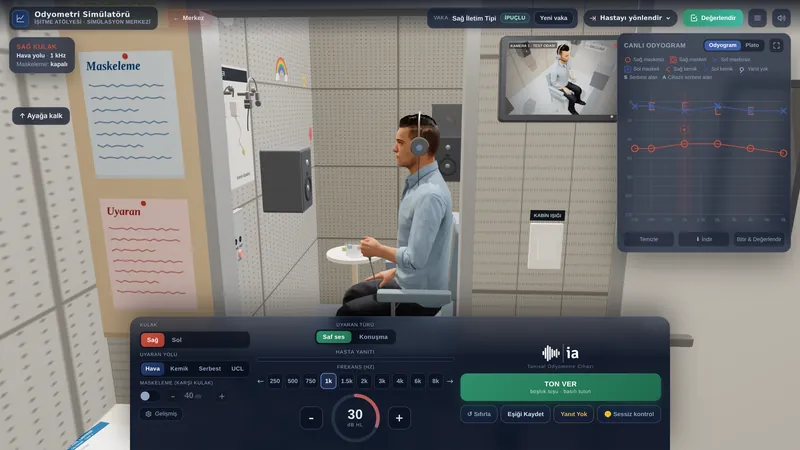
- Pure-tone audiometry: fluid or blood in the middle ear produces a mild conductive loss with an air-bone gap. In inner ear barotrauma the sensorineural loss is usually most marked in the high frequencies; a deterioration of 20 dB or more at two or more frequencies after the event suggests inner ear barotrauma (Elliott and Smart, 2014). Bone conduction should be recorded at every visit to identify a mixed picture.
- Tympanometry: a negative-pressure (type C) trace is expected early, and a flat (type B) trace with normal volume once fluid or blood collects; a perforation gives a high ear canal volume.
- Serial audiograms: when a perilymph fistula is suspected, hearing is checked daily; progressive hearing loss or worsening vestibular function calls for urgent ENT review (Nofz et al., 2020).
- Vestibular assessment: spontaneous and positional nystagmus, the video head impulse test (vHIT) and caloric testing show vestibular involvement. Cochlear findings predominate in inner ear barotrauma and vestibular findings in inner ear decompression sickness (Lindfors et al., 2021).
| Grade | Otoscopic finding |
|---|---|
| 0 | Symptoms without signs |
| 1 | Redness of the drum, especially along the malleus handle |
| 2 | Redness plus slight haemorrhage within the drum |
| 3 | Gross haemorrhage within the drum |
| 4 | Free blood in the middle ear; blue, bulging drum |
| 5 | Perforation of the drum |
In the systematic review by Lindfors and colleagues, vertigo was reported in 44.8% of inner ear barotrauma cases and 91.7% of inner ear decompression sickness cases, hearing loss in 83.1% and 28.4%, and tinnitus in 67.6% and 16.3%, respectively. Decompression sickness never began on descent, and the mean dive depth was 13 metres for barotrauma and about 43 metres for decompression sickness (Lindfors et al., 2021). When the two cannot be distinguished, the patient is managed as decompression sickness (Nofz et al., 2020).
| Feature | Inner ear barotrauma | Inner ear decompression sickness |
|---|---|---|
| Onset | Descent, ascent or afterwards | Ascent or after surfacing |
| Main involvement | Cochlear (hearing loss, tinnitus) | Vestibular (vertigo) |
| Dive profile | Shallow, difficulty equalising | Deep, long, mixed gas |
| Other findings | Middle ear barotrauma may coexist | Neurological or skin signs possible |
| Urgent treatment | Rest, surgery if needed | 100% oxygen, hyperbaric oxygen |
Treatment and audiological rehabilitation
In external ear barotrauma the cause of occlusion is removed, the canal is cleaned and a short course of topical drops may be used; diving is avoided until healing is complete (Livingstone et al., 2017). In middle ear barotrauma, inner ear involvement is excluded first. Short courses of decongestants or intranasal steroids may then be used at the doctor’s discretion, antibiotics are given for secondary infection, and a perforation that does not close spontaneously is repaired surgically. Diving is suspended until symptoms resolve, any perforation has healed and the person can equalise; suggested intervals are 7-10 days for Teed grade 0, six weeks for gross haemorrhage within the drum (grade 3) and three months for a perforation (grade 5) (Nofz et al., 2020).
Inner ear barotrauma is managed conservatively at first: bed rest with the head raised 30-40 degrees, avoiding strenuous activity for about two weeks, and avoiding straining, nose blowing, ear clearing, air travel and loud noise. Corticosteroids may be used, although high-level evidence is lacking. Severe or progressive hearing loss, incapacitating vertigo or failure to improve within ten days raises the option of exploratory tympanotomy and window repair (Elliott and Smart, 2014). Inner ear decompression sickness is an emergency: 100% oxygen and fluids are given immediately, and recompression with hyperbaric oxygen should follow as soon as possible, ideally within five hours of symptom onset (Nofz et al., 2020). When decompression sickness cannot be excluded, a trial of hyperbaric oxygen does not appear to worsen inner ear barotrauma, provided the person can equalise (Elliott and Smart, 2014).
In audiological follow-up, success is defined as hearing returning to within 15 dB of the pre-incident audiogram; persistent loss and tinnitus are managed with hearing aids and tinnitus counselling. Suggested conditions for returning to diving are a loss confined to a narrow frequency band that has stabilised, no vertigo or imbalance, mitigation of middle ear barotrauma risk factors, no anatomical risk factors and no need for further surgery; residual hearing loss alone is not a contraindication (Elliott and Smart, 2014). Return to diving is more common after barotrauma than after decompression sickness (87.1% versus 62.7%) (Lindfors et al., 2021).
Impact on quality of life and advice
When flying, frequent swallowing, yawning, chewing gum or gently blowing against a closed nose and mouth (Valsalva) is advised, especially once the descent begins; feeding babies by breast or bottle during descent encourages swallowing. Evidence for drug prevention is limited: a systematic review found oral pseudoephedrine helpful in adults but ineffective in children, and insufficient evidence for nasal balloon inflation or pressure-equalising earplugs (Ryan et al., 2018). A nasal spray used 30 minutes before descent gave no significant benefit (Mirza and Richardson, 2005). Ask your doctor before taking any medicine, and discuss postponing travel during a heavy cold or sinusitis.
When diving, the ears should be equalised early and often from the start of the descent; a diver who finds equalising difficult should descend slowly with the head up, should not continue the descent if the ears will not clear, and should avoid forceful Valsalva (Livingstone et al., 2017). A pre-dive medical check includes otoscopy and observing eardrum movement during Valsalva, and people with Eustachian tube dysfunction are advised not to dive. Decongestants are not recommended before diving because their effect may wear off underwater, and flying should be avoided for 24 hours after diving (Nofz et al., 2020).
Permanent hearing loss or vestibular damage can affect the working lives of professional divers, pilots and cabin crew. Full recovery after inner ear barotrauma may be as low as 32.5% (Lindfors et al., 2021), so people who have repeated barotrauma benefit from a detailed assessment of Eustachian tube function and from deciding about further diving together with an ENT doctor and an audiologist. If blockage or tinnitus persists, tell your audiologist; repeated measurements help to track recovery.
If you used this review, you can cite it as follows (APA 7):
Auditory Scene. (2026). Ear Barotrauma. Hearing & Balance Health Guide. https://auditoryscene.com/guncel-haberler/categories/isitme-sagligi-rehberi/kulak-barotravmasi/Permanent link: auditoryscene.com/guncel-haberler/categories/isitme-sagligi-rehberi/kulak-barotravmasi/ · Last reviewed: October 2026 · License: CC BY-NC-ND 4.0
References
- Elliott, E. J., & Smart, D. R. (2014). The assessment and management of inner ear barotrauma in divers and recommendations for returning to diving. Diving and Hyperbaric Medicine, 44(4), 208-222.
- Fijen, V. A., Westerweel, P. E., van Ooij, P. J. A. M., et al. (2016). Tympanic membrane bleeding complications during hyperbaric oxygen treatment in patients with or without antiplatelet and anticoagulant drug treatment. Diving and Hyperbaric Medicine, 46(1), 22-25.
- Lindfors, O. H., Räisänen-Sokolowski, A. K., Hirvonen, T. P., et al. (2021). Inner ear barotrauma and inner ear decompression sickness: A systematic review on differential diagnostics. Diving and Hyperbaric Medicine, 51(4), 328-337.
- Livingstone, D. M., Smith, K. A., & Lange, B. (2017). Scuba diving and otology: A systematic review with recommendations on diagnosis, treatment and post-operative care. Diving and Hyperbaric Medicine, 47(2), 97-109.
- Mirza, S., & Richardson, H. (2005). Otic barotrauma from air travel. The Journal of Laryngology & Otology, 119(5), 366-370.
- Nofz, L., Porrett, J., Yii, N., et al. (2020). Diving-related otological injuries: Initial assessment and management. Australian Journal of General Practice, 49(8), 500-504.
- Ryan, P., Treble, A., Patel, N., et al. (2018). Prevention of otic barotrauma in aviation: A systematic review. Otology & Neurotology, 39(5), 539-549.
Frequently asked questions
How can I stop my ears blocking on a plane?
Swallow, yawn or chew gum often once the descent starts; if needed, pinch your nose, close your mouth and blow gently to open your ears. Try not to be asleep during descent. Feeding a baby by breast or bottle during descent helps them swallow.
Can I fly with a cold?
A blocked nose makes it harder for the Eustachian tube to open and increases the risk of barotrauma. If you cannot postpone the trip, ask your doctor whether you should take any medicine. Some medicines have been shown to help adults but not children, so do not give your child medicine without advice.
My ear is still blocked after a flight. When will it clear?
Mild middle ear barotrauma usually settles by itself within a few days. If the blockage persists, if there is pain, discharge or marked hearing loss, or if tinnitus or dizziness develops, see an ENT doctor; a hearing test and tympanometry will show where the problem lies.
I feel dizzy after a dive. Is this an emergency?
Yes, especially if the dizziness started after surfacing, if the dive was deep or long, or if there are other symptoms such as numbness in the arms or a skin rash. This may be inner ear decompression sickness, which needs hyperbaric oxygen treatment within hours. Call for emergency help and breathe 100% oxygen if it is available.
When can I dive again after ear barotrauma?
Your symptoms should have cleared, the eardrum should have healed and you should be able to equalise easily. The waiting time ranges from a few days to three months depending on the severity of the injury. After an inner ear injury, the decision should be made with an ENT doctor and an audiologist on the basis of hearing and balance tests.
Is hearing loss from barotrauma permanent?
Hearing loss caused by fluid or blood in the middle ear usually recovers. After inner ear barotrauma, hearing loss and tinnitus can be permanent; early diagnosis, rest and surgery when needed improve the chance of recovery. Hearing aids and tinnitus counselling help if some loss remains.
A scale that can be used to assess the Eustachian tube symptoms that predispose to barotrauma: